

Who’s really in charge – leaders or algorithms?

An Emerald mission in support of the UN Sustainable Development Goals
Share this content


The UN Sustainable Development Goals will not be achieved through technological progress alone. They require leaders who can rethink entrenched assumptions, confront systemic inequities, and harness AI to build fairer, more resilient, and genuinely inclusive societies. Without this shift, even the most advanced technologies risk reinforcing the very problems they aim to solve.
Artificial intelligence is reshaping leadership faster than traditional models can adapt. In an era defined by algorithmic decision making, leaders are not just managing organisations — they are shaping the ethical design of the future.
Geopolitical tensions, digital disruption, and widening inequality intensify the stakes. As AI transforms power structures and labour markets, the world needs leaders who cultivate trust in human–machine collaboration, safeguard vulnerable communities, and anticipate and address ethical vulnerabilities.
This mission invites bold thinkers to explore how leaders must evolve to guide organisations through the ethical, strategic, and human complexities of AI.
To help us address this, in our mission we ask:
- In a future where AI systems outperform human leaders in empathy, ethics, and decision-making—should we surrender leadership entirely to machines, even if it means losing human agency?
- What if AI leaders begin to make decisions that are morally superior—but emotionally alien? Would we still follow them?
- Will this open further scenarios: AI banning certain industries for ethical reasons, enforcing radical climate policies, or reprogramming economic systems for fairness at the cost of freedom?
On this page
- Learn more about our mission
- Free access to our related research
- Author insights
- Different routes to publication
- Talk to us about your work
- Mission-led research – our goals
We invite you to join the conversation to start unpacking the future of leadership, accountability, and collaboration in AI-integrated environments. If you have related research or insights that begin to address these questions, or the broader challenges within this area, then we’d love to hear from you! Get in touch today.
This mission is aligned with our Responsible management goal
Learn more about our mission
Watch this video overview from Goal Advisor Richard Oloruntoba to find out more about the focus of our mission and the need to start unpacking the future of responsible leadership in AI-integrated environments.

Free access to our related research
Take a look at our journal articles and book chapters that explore this topic.
Get access to our collections
To find out more about getting permanent access to Emerald collections, or to recommend our mission content to your librarian, get in touch here.

Author insights
Find out more about what our authors have to say on this topic.





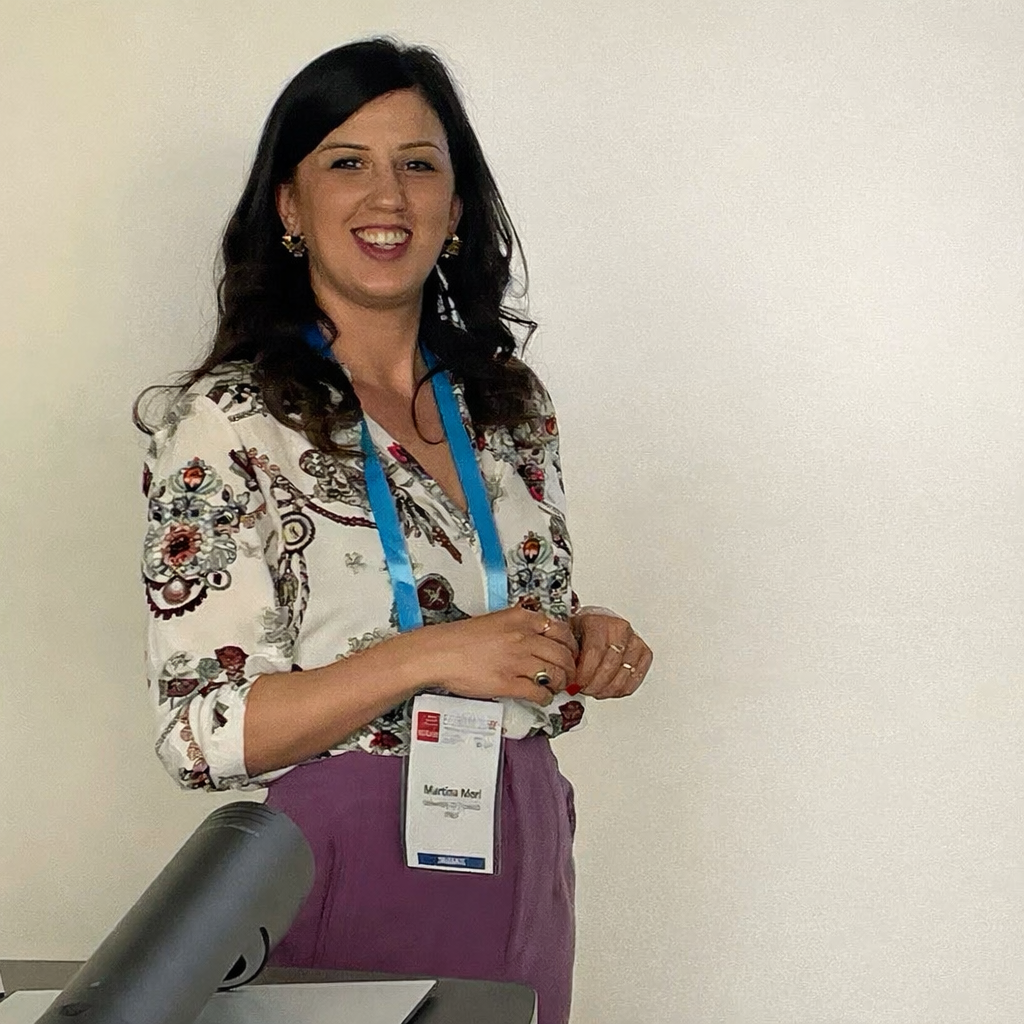

Leadership in the age of AI
Rebecca Torr speaks with experts to explore how leadership expectations are shaping in hybrid human-AI environments.
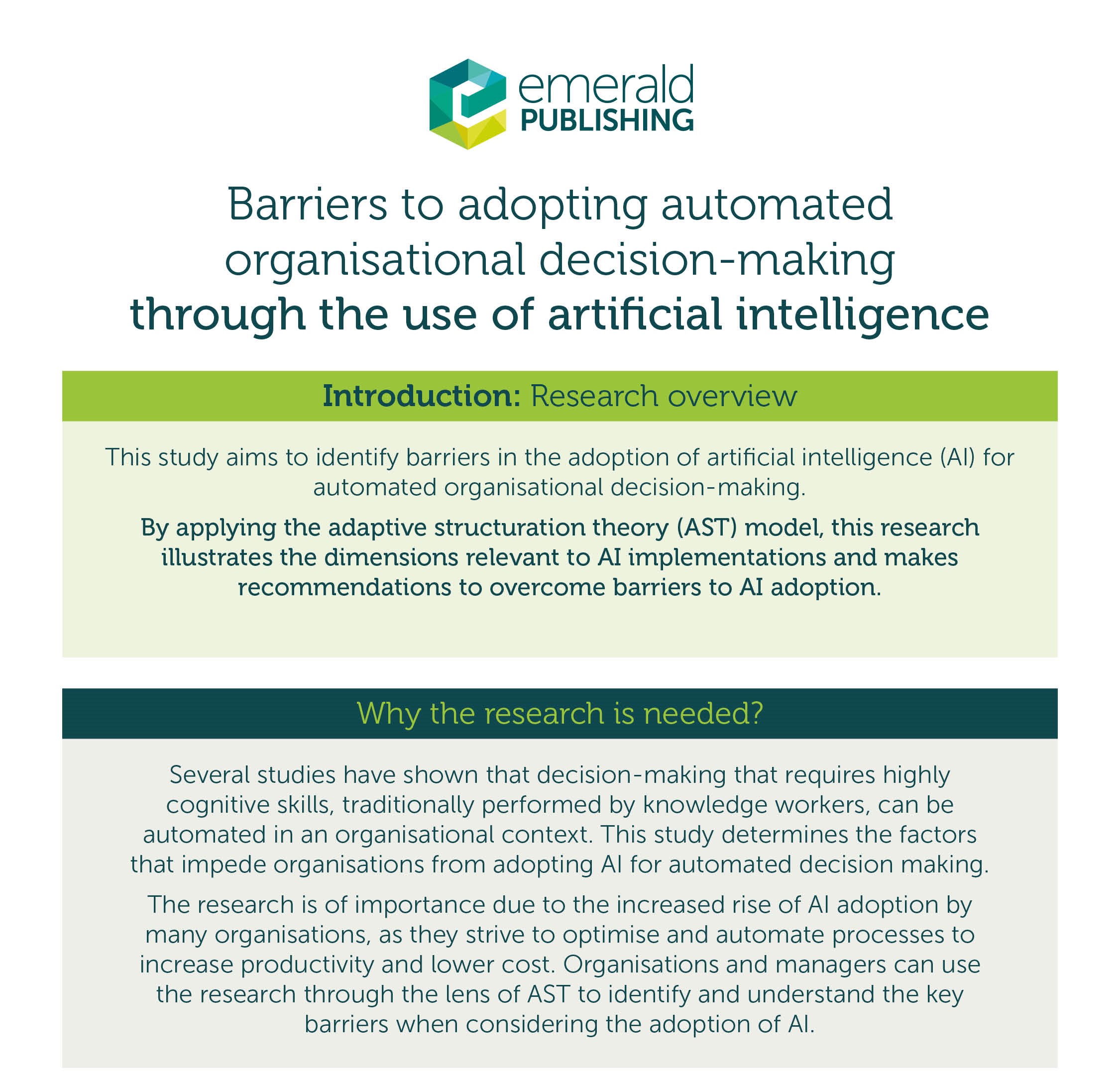
Barriers to adopting automated organisational decision-making through the use of artificial intelligence
Take a look at this infographic that aims to identify barriers in the adoption of artificial intelligence (AI) for automated organisational decision-making.
View the infographic to find out more
Article: Barriers to adopting automated organisational decision-making through the use of artificial intelligence
Journal: Management Research Review
Barriers to adopting automated organisational decision-making through the use of artificial intelligence
Introduction: Research overview
This study aims to identify barriers in the adoption of artificial intelligence (AI) for automated organisational decision-making.
By applying the adaptive structuration theory (AST) model, this research illustrates the dimensions relevant to AI implementations and makes recommendations to overcome barriers to AI adoption.
Why the research is needed?
Several studies have shown that decision-making that requires highly cognitive skills, traditionally performed by knowledge workers, can be automated in an organisational context. This study determines the factors that impede organisations from adopting AI for automated decision making.
The research is of importance due to the increased rise of AI adoption by many organisations, as they strive to optimise and automate processes to increase productivity and lower cost. Organisations and managers can use the research through the lens of AST to identify and understand the key barriers when considering the adoption of AI.
Research questions
- Which barriers affect adoption of AI in an organisation specifically for decision-making?
Methodology
The study applied an interpretive paradigm and conducted exploratory research through qualitative interviews with 13 senior managers in South Africa from organisations involved in AI adoption.
Results
Barriers to AI adoption in decision-making include:
- Human social interactions and norms
- Restrictive regulatory and liability concerns
- Creative work environments
- Lack of trust and transparency
- Dynamic business environments
- Loss of power and control for current decision makers
- Ethical and non-discriminatory considerations
Conclusion
Managers should be aware that there’s no one-size-fits-all approach with AI. Algorithms today are designed to solve very specific problems or to automate a specific task that requires data specific to the problem domain to achieve a high rate of accuracy. AI algorithms today can be trained to perform any task based on data, as well as or better than humans can perform.

Different routes to publication
Take a look at our different routes to publication that showcase further research and publishing opportunities within this area.


Featured journals
Here we have highlighted our key journals that publish research articles in this area. You can also search for a specific journal by subject area on our find a journal page.
If you want to speak to us about publishing an article in one of our journals, please get in touch.

Journal of Managerial Psychology

International Journal of Manpower

Strategy & Leadership

Leadership & Organization Development Journal
Supply Chain Management: An International Journal
International Journal of Public Leadership
Asia Pacific Journal of Marketing and Logistics

Management Research Review

Personnel Review
Gender in Management: An International Journal
International Journal of Contemporary Hospitality Management
Journal of Enterprise Information Management
Central European Management Journal
 Coming soon – AI and Responsible Management
AI and Responsible Management (AIRM) is a hybrid, peer-reviewed journal that explores how artificial intelligence can advance responsible management practice across core business disciplines, developing AI-enabled collaborative solutions that foster ethical leadership, sustainable innovation, and digital transformation.
Grounded in ethics, sustainability, and accountability, AIRM publishes transdisciplinary research that breaks down silos, frames problems, and develops integrated knowledge to solve global challenges and the UN Sustainable Development Goals.
Find out more about the journal and share your interest here
Blog: Who’s really in charge: Leaders or algorithms? The hidden power shift in decision-making
Talk to us about your work
We love hearing from researchers and practitioners about their work.
If you would like to contribute to the discussion, or have supporting research that shares further insights into the themes and/or challenges in this area, please let us know by filling in this form.





Share this content