
You can publish an open access article in this diamond partnership journal. Authors in this journal are not required to pay an article processing charge (APC)
Before you start
For queries relating to the status of your paper pre decision, please contact the Editor or Journal Editorial Office. For queries post acceptance, please contact the Supplier Project Manager. These details can be found in the Editorial Team section.
Author responsibilities
Our goal is to provide you with a professional and courteous experience at each stage of the review and publication process. There are also some responsibilities that sit with you as the author. Our expectation is that you will:
- Respond swiftly to any queries during the publication process.
- Be accountable for all aspects of your work. This includes investigating and resolving any questions about accuracy or research integrity
- Treat communications between you and the journal editor as confidential until an editorial decision has been made.
- Read about our research ethics for authorship. These state that you must:
- Include anyone who has made a substantial and meaningful contribution to the submission (anyone else involved in the paper should be listed in the acknowledgements).
- Exclude anyone who hasn’t contributed to the paper, or who has chosen not to be associated with the research.
- In accordance with COPE’s position statement on AI tools, Large Language Models cannot be credited with authorship as they are incapable of conceptualising a research design without human direction and cannot be accountable for the integrity, originality, and validity of the published work.
- If your article involves human participants, you must ensure you have considered whether or not you require ethical approval for your research, and include this information as part of your submission. Find out more about informed consent.
Emerald’s Policy on AI Usage
Emerald’s overarching principles of AI usage:
1) Authors and peer reviewers are responsible and accountable for the accuracy and integrity of their work.&
2) AI tools and technology must be used responsibly and transparently.
3) AI tools and technology should not replace human involvement in the publication process but instead supplement it.
Copywriting (creating, drafting, or writing) any part of a submission using generative AI tools and technology to generate new material is not permitted.
Copy-editing (correcting, editing, formatting, modifying, or refining) all or part of an author’s own original existing work using generative AI tools and technology the content to improve its structure and the clarity of the language and grammar is permitted, ensuring users adhere to the following overarching principles.
Emerald’s full policy, including examples of use cases can be found on our Publishing Ethics page.
Research and publishing ethics
Our editors and employees work hard to ensure the content we publish is ethically sound. To help us achieve that goal, we closely follow the advice laid out in the guidelines and flowcharts on the COPE (Committee on Publication Ethics) website.
We have also developed our research and publishing ethics guidelines. If you haven’t already read these, we urge you to do so – they will help you avoid the most common publishing ethics issues.
A few key points:
- Any manuscript you submit to this journal should be original. That means it should not have been published before in its current, or similar, form. Exceptions to this rule are outlined in our pre-print and conference paper policies. If any substantial element of your paper has been previously published, you need to declare this to the journal editor upon submission. Please note, the journal editor may use Crossref Similarity Check to check on the originality of submissions received. This service compares submissions against a database of 49 million works from 800 scholarly publishers.
- Your work should not have been submitted elsewhere and should not be under consideration by any other publication.
- If you have a conflict of interest, you must declare it upon submission; this allows the editor to decide how they would like to proceed. Read about conflict of interest in our research and publishing ethics guidelines.
- By submitting your work to Emerald, you are guaranteeing that the work is not in infringement of any existing copyright.
Third party copyright permissions
Prior to article submission, you need to ensure you’ve applied for, and received, written permission to use any material in your manuscript that has been created by a third party. Please note, we are unable to publish any article that still has permissions pending. The rights we require are:
- Non-exclusive rights to reproduce the material in the article or book chapter.
- Print and electronic rights.
- Worldwide English-language rights.
- To use the material for the life of the work. That means there should be no time restrictions on its re-use e.g. a one-year licence.
We are a member of the International Association of Scientific, Technical, and Medical Publishers (STM) and participate in the STM permissions guidelines, a reciprocal free exchange of material with other STM publishers. In some cases, this may mean that you don’t need permission to re-use content. If so, please highlight this at the submission stage.
Please take a few moments to read our guide to publishing permissions to ensure you have met all the requirements, so that we can process your submission without delay.
Open access information
This is a sponsored open access journal, also referred to as diamond open access. Because it is published in partnership with an organisation, your article will be published open access, but you will not have to pay an APC (article processing charge) - publication is free. Your article will be published with a Creative Commons CC BY 4.0 user licence, which outlines how readers can reuse your work.
You can find out more about our open access routes and read our FAQs on our open research page.
Transparency and Openness Promotion (TOP) Guidelines
We are a signatory of the Transparency and Openness Promotion (TOP) Guidelines, a framework that supports the reproducibility of research through the adoption of transparent research practices. That means we encourage you to:
- Cite and fully reference all data, program code, and other methods in your article.
- Include persistent identifiers, such as a Digital Object Identifier (DOI), in references for datasets and program codes. Persistent identifiers ensure future access to unique published digital objects, such as a piece of text or datasets. Persistent identifiers are assigned to datasets by digital archives, such as institutional repositories and partners in the Data Preservation Alliance for the Social Sciences (Data-PASS).
- Follow appropriate international and national procedures with respect to data protection, rights to privacy and other ethical considerations, whenever you cite data. For further guidance please refer to our research and publishing ethics guidelines. For an example on how to cite datasets, please refer to the references section below.
Prepare your submission
Manuscript support services
We are pleased to partner with Editage, a platform that connects you with relevant experts in language support, translation, editing, visuals, consulting, and more. After you’ve agreed a fee, they will work with you to enhance your manuscript and get it submission-ready.
This is an optional service for authors who feel they need a little extra support. It does not guarantee your work will be accepted for review or publication.
Manuscript requirements
Before you submit your manuscript, it’s important you read and follow the guidelines below. You will also find some useful tips in our structure your journal submission how-to guide.
| Format | Article files should be provided in Microsoft Word format While you are welcome to submit a PDF of the document alongside the Word file, PDFs alone are not acceptable. LaTeX files can also be used but only if an accompanying PDF document is provided. Acceptable figure file types are listed further below. |
| Article length / word count | Articles should be a maximum of 8000 words in length. This includes all text, for example, the structured abstract, references, all text in tables, and figures and appendices. Please allow 280 words for each figure or table. |
| Article title | A concisely worded title should be provided. |
| Author details | The names of all contributing authors should be added to the ScholarOne submission; please list them in the order in which you’d like them to be published. Each contributing author will need their own ScholarOne author account, from which we will extract the following details:
In multi-authored papers, it’s important that ALL authors that have made a significant contribution to the paper are listed. Those who have provided support but have not contributed to the research should be featured in an acknowledgements section. You should never include people who have not contributed to the paper or who don’t want to be associated with the research. Read about our research ethics for authorship. |
| Biographies and acknowledgements | If you want to include these items, save them in a separate Microsoft Word document and upload the file with your submission. Where they are included, a brief professional biography of not more than 100 words should be supplied for each named author. |
| Research funding | Your article must reference all sources of external research funding in the acknowledgements section. You should describe the role of the funder or financial sponsor in the entire research process, from study design to submission. |
| Structured abstract | All submissions must include a structured abstract, following the format outlined below. These four sub-headings and their accompanying explanations must always be included:
The following three sub-headings are optional and can be included, if applicable:
The maximum length of your abstract should be 250 words in total, including keywords and article classification (see the sections below). |
| Keywords | Your submission should include up to 12 appropriate and short keywords that capture the principal topics of the paper. Our Creating an SEO-friendly manuscript how to guide contains some practical guidance on choosing search-engine friendly keywords. Please note, while we will always try to use the keywords you’ve suggested, the in-house editorial team may replace some of them with matching terms to ensure consistency across publications and improve your article’s visibility. |
| Article classification | During the submission process, you will be asked to select a type for your paper; the options are listed below. If you don’t see an exact match, please choose the best fit: You will also be asked to select a category for your paper. The options for this are listed below. If you don’t see an exact match, please choose the best fit: Research paper. Reports on any type of research undertaken by the author(s), including:
Viewpoint. Covers any paper where content is dependent on the author's opinion and interpretation. This includes journalistic and magazine-style pieces. Technical paper. Describes and evaluates technical products, processes or services. Conceptual paper. Focuses on developing hypotheses and is usually discursive. Covers philosophical discussions and comparative studies of other authors’ work and thinking. Case study. Describes actual interventions or experiences within organizations. It can be subjective and doesn’t generally report on research. Also covers a description of a legal case or a hypothetical case study used as a teaching exercise. Literature review. This category should only be used if the main purpose of the paper is to annotate and/or critique the literature in a particular field. It could be a selective bibliography providing advice on information sources, or the paper may aim to cover the main contributors to the development of a topic and explore their different views. General review. Provides an overview or historical examination of some concept, technique or phenomenon. Papers are likely to be more descriptive or instructional (‘how to’ papers) than discursive. |
| Headings | Headings must be concise, with a clear indication of the required hierarchy. The preferred format is for first level headings to be in bold, and subsequent sub-headings to be in medium italics. |
| Notes/endnotes | Notes or endnotes should only be used if absolutely necessary. They should be identified in the text by consecutive numbers enclosed in square brackets. These numbers should then be listed, and explained, at the end of the article. |
| Figures | All figures (charts, diagrams, line drawings, webpages/screenshots, and photographic images) should be submitted electronically. Both colour and black and white files are accepted.
|
| Tables | Tables should be typed and submitted in a separate file to the main body of the article. The position of each table should be clearly labelled in the main body of the article with corresponding labels clearly shown in the table file. Tables should be numbered consecutively in Roman numerals (e.g. I, II, etc.). Give each table a brief title. Ensure that any superscripts or asterisks are shown next to the relevant items and have explanations displayed as footnotes to the table, figure or plate. |
| Supplementary files | Where tables, figures, appendices, and other additional content are supplementary to the article but not critical to the reader’s understanding of it, you can choose to host these supplementary files alongside your article on Insight, Emerald’s content-hosting platform (this is Emerald's recommended option as we are able to ensure the data remain accessible), or on an alternative trusted online repository. Emerald recommends authors that they use the following two trusted lists of repositories: https://commons.datacite.org/repositories and https://www.re3data.org to identify the most suitable repository. Any and all supplementary material must be present/provided with the initial submission. If you choose to host your supplementary files on Insight, you must submit these as separate files alongside your article. Files should be clearly labelled in such a way that makes it clear they are supplementary; Emerald recommends that the file name is descriptive and that it follows the format 'Supplementary_material_appendix_1' or 'Supplementary tables'. All supplementary material must be mentioned at the appropriate moment in the main text of the article; there is no need to include the content of the file only the file name. A link to the supplementary material will be added to the article during production, and the material will be made available alongside the main text of the article at the point of EarlyCite publication. Please note that Emerald will not make any changes to the material; it will not be copy-edited or typeset, and authors will not receive proofs of this content. Emerald therefore strongly recommends that you style all supplementary material ahead of acceptance of the article.
If you choose to use an alternative trusted online repository, you should ensure that the supplementary material is hosted on the repository ahead of submission, and then include a link only to the repository within the article. It is the responsibility of the submitting author to ensure that the material is free to access and that it remains permanently available. Where an alternative trusted online repository is used, the files hosted should always be presented as read-only; please be aware that such usage risks compromising your anonymity during the review process if the repository contains any information that may enable the reviewer to identify you; as such, we recommend that all links to alternative repositories are reviewed carefully prior to submission. Please note that extensive supplementary material may be subject to peer review; this is at the discretion of the journal Editor and dependent on the content of the material (for example, whether including it would support the reviewer making a decision on the article during the peer review process). |
| References | References to other publications must be in APA style and carefully checked for completeness, accuracy and consistency. This is very important in an electronic environment because it enables your readers to exploit the Reference Linking facility on the database and link back to the works you have cited through CrossRef. You should cite publications in the text: (Adams, 2006) using the first named author's name or (Adams and Brown, 2006) citing both names of two, or (Adams et al., 2006), when there are three or more authors. At the end of the paper a reference list in alphabetical order should be supplied. |
| For books | Surname, Initials. (Year). Title of book. Publisher. e.g. Harrow, R. (2005). No Place to Hide. Simon & Schuster. |
| For book chapters | Surname, Initials. (Year). "Chapter Title", in Editor's Surname, Initials (Ed.), title of book (page numbers). Publisher. e.g. Calabrese, F.A. (2005). "The early pathways: theory to practice – a continuum". In Stankosky, M. (Ed.), Creating the Discipline of Knowledge Management (pp. 15-20). Elsevier. |
| For journals | Surname, initials. (Year). "title of article". Journal name, volume(issue), page numbers. DOI. e.g. Capizzi, M.T. and Ferguson, R. (2005). "Loyalty trends for the twenty-first century". Journal of Consumer Marketing, 22(2), 72-80. DOI. |
| For published conference proceedings | Surname, initials (year of publication), "title of paper", in editor’s surname, initials (Ed.), title of published proceeding which may include place and date(s) held, publisher, place of publication, page numbers. e.g. Wilde, S. and Cox, C. (2008), “Principal factors contributing to the competitiveness of tourism destinations at varying stages of development”, in Richardson, S., Fredline, L., Patiar A., & Ternel, M. (Ed.s), CAUTHE 2008: Where the 'bloody hell' are we?, Griffith University, Gold Coast, Qld, pp.115-118. |
| For unpublished conference proceedings | Surname, initials (year), "title of paper", paper presented at [name of conference], [date of conference], [place of conference], available at: URL if freely available on the internet (accessed date). e.g. Aumueller, D. (2005), "Semantic authoring and retrieval within a wiki", paper presented at the European Semantic Web Conference (ESWC), 29 May-1 June, Heraklion, Crete, available at: http://dbs.uni-leipzig.de/file/aumueller05wiksar.pdf (accessed 20 February 2007). |
| For working papers | Surname, initials (year), "title of article", working paper [number if available], institution or organization, place of organization, date. e.g. Moizer, P. (2003), "How published academic research can inform policy decisions: the case of mandatory rotation of audit appointments", working paper, Leeds University Business School, University of Leeds, Leeds, 28 March. |
| For encyclopaedia entries (with no author or editor) | Title of encyclopaedia (year), "title of entry", volume, edition, title of encyclopaedia, publisher, place of publication, page numbers. e.g. Encyclopaedia Britannica (1926), "Psychology of culture contact", Vol. 1, 13th ed., Encyclopaedia Britannica, London and New York, NY, pp.765-771. (for authored entries, please refer to book chapter guidelines above) |
| For newspaper articles (authored) | Surname, initials (year), "article title", newspaper, date, page numbers. e.g. Smith, A. (2008), "Money for old rope", Daily News, 21 January, pp.1, 3-4. |
| For newspaper articles (non-authored) | Newspaper (year), "article title", date, page numbers. e.g. Daily News (2008), "Small change", 2 February, p.7. |
| For archival or other unpublished sources | Surname, initials (year), "title of document", unpublished manuscript, collection name, inventory record, name of archive, location of archive. e.g. Litman, S. (1902), "Mechanism & Technique of Commerce", unpublished manuscript, Simon Litman Papers, Record series 9/5/29 Box 3, University of Illinois Archives, Urbana-Champaign, IL. |
| For electronic sources | If available online, the full URL should be supplied at the end of the reference, as well as the date that the resource was accessed. Surname, initials (year), “title of electronic source”, available at: persistent URL (accessed date month year). e.g. Weida, S. and Stolley, K. (2013), “Developing strong thesis statements”, available at: https://owl.english.purdue.edu/owl/resource/588/1/ (accessed 20 June 2018) Standalone URLs, i.e. those without an author or date, should be included either inside parentheses within the main text, or preferably set as a note (Roman numeral within square brackets within text followed by the full URL address at the end of the paper). |
| For data | Surname, initials (year), title of dataset, name of data repository, available at: persistent URL, (accessed date month year). e.g. Campbell, A. and Kahn, R.L. (2015), American National Election Study, 1948, ICPSR07218-v4, Inter-university Consortium for Political and Social Research (distributor), Ann Arbor, MI, available at: https://doi.org/10.3886/ICPSR07218.v4 (accessed 20 June 2018) |
Submit your manuscript
There are a number of key steps you should follow to ensure a smooth and trouble-free submission.
Double check your manuscript
Before submitting your work, it is your responsibility to check that the manuscript is complete, grammatically correct, and without spelling or typographical errors. A few other important points:
- Give the journal aims and scope a final read. Is your manuscript definitely a good fit? If it isn’t, the editor may decline it without peer review.
- Does your manuscript comply with our research and publishing ethics guidelines?
- Have you cleared any necessary publishing permissions?
- Have you followed all the formatting requirements laid out in these author guidelines?
- Does the manuscript contain any information that might help the reviewer identify you? This could compromise the anonymous peer review process. A few tips:
- If you need to refer to your own work, use wording such as ‘previous research has demonstrated’ not ‘our previous research has demonstrated’.
- If you need to refer to your own, currently unpublished work, don’t include this work in the reference list.
- Any acknowledgments or author biographies should be uploaded as separate files.
- Carry out a final check to ensure that no author names appear anywhere in the manuscript. This includes in figures or captions.
You will find a helpful submission checklist on the website Think.Check.Submit.
The submission process
All manuscripts should be submitted through our editorial system by the corresponding author.
A separate author account is required for each journal you submit to. If this is your first time submitting to this journal, please choose the Create an account or Register now option in the editorial system. If you already have an Emerald login, you are welcome to reuse the existing username and password here.
Please note, the next time you log into the system, you will be asked for your username. This will be the email address you entered when you set up your account.
Don't forget to add your ORCiD ID during the submission process. It will be embedded in your published article, along with a link to the ORCiD registry allowing others to easily match you with your work.
Don’t have one yet? It only takes a few moments to register for a free ORCiD identifier.
Visit the ScholarOne support centre for further help and guidance.
What you can expect next
You will receive an automated email from the journal editor, confirming your successful submission. It will provide you with a manuscript number, which will be used in all future correspondence about your submission. If you have any reason to suspect the confirmation email you receive might be fraudulent, please contact our Rights team on [email protected]
Post submission
Review and decision process
Each submission is checked by the editor. At this stage, they may choose to decline or unsubmit your manuscript if it doesn’t fit the journal aims and scope, or they feel the language/manuscript quality is too low.
If they think it might be suitable for the publication, they will send it to at least two independent referees for double anonymous peer review. Once these reviewers have provided their feedback, the editor may decide to accept your manuscript, request minor or major revisions, or decline your work.
While all journals work to different timescales, the goal is that the editor will inform you of their first decision within 60 days.
During this period, we will send you automated updates on the progress of your manuscript via our submission system, or you can log in to check on the current status of your paper. Each time we contact you, we will quote the manuscript number you were given at the point of submission. If you receive an email that does not match these criteria, it could be fraudulent and we recommend you email [email protected].
If your submission is accepted
Copyright
All accepted authors are sent an email with a link to a licence form. This should be checked for accuracy, for example whether contact and affiliation details are up to date and your name is spelled correctly, and then returned to us electronically. If there is a reason why you can’t assign copyright to us, you should discuss this with your journal content editor. You will find their contact details on the editorial team section above.
Proofing and typesetting
Once we have received your completed licence form, the article will pass directly into the production process. We will carry out editorial checks, copyediting, and typesetting and then return proofs to you (if you are the corresponding author) for your review. This is your opportunity to correct any typographical errors, grammatical errors or incorrect author details. We can’t accept requests to rewrite texts at this stage.
When the page proofs are finalised, the fully typeset and proofed version of record is published online. This is referred to as the EarlyCite version. While an EarlyCite article has yet to be assigned to a volume or issue, it does have a digital object identifier (DOI) and is fully citable. It will be compiled into an issue according to the journal’s issue schedule, with papers being added by chronological date of publication.
How to share your paper
Visit our author rights page to find out how you can reuse and share your work.
To find tips on increasing the visibility of your published paper, read about how to promote your work.
Correcting inaccuracies in your published paper
Sometimes errors are made during the research, writing and publishing processes. When these issues arise, we have the option of withdrawing the paper or introducing a correction notice. Find out more about our article withdrawal and correction policies.
Need to make a change to the author list? See our frequently asked questions (FAQs) below.
Frequently asked questions
| Is there a submission fee for the journal? | The only time we will ever ask you for money to publish in an Emerald journal is if you have chosen to publish via the gold open access route. You will be asked to pay an APC (article processing charge) once your paper has been accepted (unless it is a sponsored open access journal). At no other time will you be asked to contribute financially towards your article’s publication. If you haven’t chosen gold open access and you receive an email which appears to be from Emerald, asking you for payment to publish, please contact our Rights team on [email protected] |
| How can I become a reviewer for a journal? | Please contact the editor for the journal, with a copy of your CV. You will find their contact details on the editorial team tab on this page. |
| Who do I contact if I want to find out which volume and issue my accepted paper will appear in? | Typically, papers are added to an issue according to their date of publication. If you would like to know in advance which issue your paper will appear in, please contact the content editor of the journal. You will find their contact details on the editorial team tab on this page. Once your paper has been published in an issue, you will be notified by email. |
| Who do I contact if I have a query about my submission? | Please email the journal editor – you will find their contact details on the editorial team tab on this page. If you ever suspect an email you’ve received from Emerald might not be genuine, you are welcome to verify it with the content editor for the journal, whose contact details can be found on the editorial team tab on this page. Alternatively, you can email our Rights team. |
| Is my paper suitable for the journal? | If you’ve read the aims and scope on the journal landing page and are still unsure whether your paper is suitable for the journal, please email the editor and include your paper's title and structured abstract. They will be able to advise on your manuscript’s suitability. You will find their contact details on the Editorial team tab on this page. |
| How do I make a change to the list of authors once the manuscript has been submitted? | Authorship and the order in which the authors are listed on the paper should be agreed prior to submission. If you need to make any changes to the author information once the paper is under review or has been accepted, we will look into your request and closely follow the Committee on Publication Ethics (COPE) authorship guidelines. We will also require a statement from each author confirming their agreement. |
-
Editor-in-Chief
-
Paweł
Korzyński
Kozminski University, Poland
-
Paweł
Korzyński
-
Editorial Assistant
-
Anna
Gorynska
Kozminski University, Poland
[email protected]
-
Anna
Gorynska
-
Publisher
-
Sophia
Walton
Emerald Publishing
[email protected]
-
Sophia
Walton
-
Journal Editorial Office (For queries related to pre-acceptance)
-
Please contact the Journal Editorial Office
[email protected]
-
Please contact the Journal Editorial Office
-
Supplier Project Manager (For queries related to post-acceptance)
-
Sivakeerthika
Saravanan
Emerald Publishing
[email protected]
-
Sivakeerthika
Saravanan
-
Associate Editors
-
Domenico
Buccella
Kozminski University, Poland
-
Izabela
Kowalik
Warsaw School of Economics, Poland
-
Regina
Lenart-Gansiniec
Department of Management of Higher Education Institutions, Jagiellonian University, Poland
-
Nicola
Meccheri
University of Pisa, Italy
-
Jordi
Paniagua
Catholic University of Valencia, Spain
-
Urban
Pauli
Krakow University of Economics, Poland
-
Marta
Postuła
University of Warsaw, Poland
-
Edyta
Rudawska
University of Szczecin, Poland
-
Bruno
Schivinski
RMIT University, Melbourne, Australia
-
Marcella
Scrimitore
Mediterranean University of Reggio Calabria, Italy
-
Anna
Sender
University of Lucerne, Switzerland
-
Dariusz
Siemieniako
Bialystok University of Technology - Poland
-
Jan Jakub
Szczygielski
University of Pretoria, South Africa
-
Krzysztof
Wach
Cracow University of Economics, Poland
-
André
van Stel
Trinity Business School (Trinity College Dublin), Ireland
-
Domenico
Buccella
-
Editorial Board
-
Mariusz
Andrzejewski
Cracow University of Economics, Poland
-
Heidrich
Balazs
Budapest Business School, Hungary
-
Zbigniew
Bochniarz
University of Washington, US
-
Paweł
Bryła
University of Lodz, Poland
-
Zoltan
Buzady
Corvinus Business School, Hungary
-
Peter
Caracsony
University J. Selyeho, Slovakia
-
Nick
Chandler
Budapest Business School, Hungary
-
Gosia
Ciesielska
Teesside University Business School, United Kingdom
-
Sylwia
Ciuk
Oxford Brookes University Business School, United Kingdom
-
Giovanna
Devetag
LUISS Universita Guido Carli, Italy
-
Linying (Lin)
Dong
Ryerson University, Canada
-
Kurt Johnny Burneo
Farfan
Centrum Graduate Business School, Pontifica Universidad Catolica del Peru, Peru
-
Percy S. Marquina
Feldman
Centrum Graduate Business School, Pontifica Universidad Catolica del Peru, Peru
-
Toshio
Goto
Japan University of Economics, Japan
-
Giuseppe
Grossi
Kristianstad University, Sweden
-
Julita
Haber
Fordam University, USA
-
Gábor
Harangozó
Corvinus University of Budapest, Hungary
-
Ilona
Hunek
University College Dublin, Ireland
-
Krzysztof
Jackowicz
Kozminski University, Poland
-
Sebastian
Jarzębowski
Kozminski University - Poland
-
Zvi
Joshman
Bar-Ilan University, Israel
-
Eugeniusz
Kaciak
Brock University, Ontario, Canada
-
Andreas
Kaplan
ESCP Europe, France
-
Izabela
Koladkiewicz
Kozminski University, Poland
-
Oskar
Kowalewski
IESEG School of Management, France
-
Józefa
Kramer
University of Economics in Katowice, Poland
-
Anna
Lis
Gdansk University of Technology, Poland
-
Jasmin
Mahadevan
Pforzheim University - Pforzheim, Germany
-
Monika
Marcinkowska
University of Lodz, Poland
-
Gianluca
Mattarocci
LUISS Universita Guido Carli, Italy
-
Czesław
Mesjasz
Cracow University of Economics, Poland
-
Paweł
Mielcarz
Kozminski University, Poland
-
Henryk
Mruk
Poznan University of Economics, Poland
-
Jan
Napoleon
Duquesne University, Pittsburgh University, USA
-
Bogdan
Nogalski
University of Gdańsk, Poland
-
Bartłomiej
Nowak
Kozminski University, Poland
-
Daria
Peljhan
University of Ljubljana, Slovenia
-
Oksana
Polinkevych
Lesya Ukrainka Eastern European National University, Ukraine
-
Narcyz
Roztocki
State University of New York, New Patlz, USA
-
Robert
Rządca
Kozminski University, Poland
-
Giovanni
Schiuma
University of Basilicata, Italy
-
Zeljko
Sevic
Caledonian Business School, UK
-
Dariusz
Siemieniako
Bialystok University of Technology - Poland
-
JC
Spender
Lund University, Sweden
-
Abdulsatar Abduljabar
Sultan
Lebanese French University, Iraq
-
Charles
Vincent
Centrum Graduate Business School, Pontifica Universidad Catolica del Peru
-
Maciej
Zastempowski
Nicolaus Copernicus University, Poland
-
Rong
Zhang
Nishinippon Institute of Technology, Japan
-
Mariusz
Andrzejewski
Citation metrics

5.0
CiteScore 2025
5.0
CiteScore 2025
6.6
CiteScore Tracker 2026
(updated monthly)
6.6
CiteScore Tracker 2026
(updated monthly)

2.8
2025 Impact Factor
2.8
2025 Impact Factor
2.1
5-year Impact Factor (2025)
2.1
5-year Impact Factor (2025)
Publication timeline
Time to first decision
36
days
Time to first decision
36
days
Acceptance to publication
84
days
Acceptance to publication
84
days
Acceptance rate
10.6
%
Acceptance rate
10.6
%
Usage
Downloads
23200
Articles
Downloads
23200
Articles
This journal is included in the following abstract and indexing services:
- Arianta
- Baidu Scholar
- BazEkon
- BazHum
- Cabells
- CEJSH (The Central European Journal of Social Sciences and Humanities)
- Chartered Association of Business Schools (CABS)
- CNKI Scholar (China National Knowledge Infrastructure)
- CNPIEC - cnpLINKer
- Dimensions
- DOAJ (Directory of Open Access Journals)
- EBSCO (relevant databases)
- EBSCO Discovery Service
- EconBiz
- ERIH PLUS (European Reference Index for the Humanities and Social Sciences)
- Google Scholar
- Index Copernicus
- J-Gate
- JournalTOCs
- KESLI-NDSL (Korean National Discovery for Science Leaders)
- Microsoft Academic
- MyScienceWork
- Naver Academic
- Naviga (Softweco)
- POL-index
- Primo Central (ExLibris)
- ProQuest (relevant databases)
- Publons
- QOAM (Quality Open Access Market)
- ReadCube
- Research Papers in Economics (RePEc)
- SCImago (SJR)
- SCOPUS
- Semantic Scholar
- Summon (ProQuest)
- TDNet
- TEMA Technik und Management
- Ulrich's Periodicals Directory/Ulrichsweb
- WanFang Data
- Web of Science - Emerging Sources Citation Index
- WorldCat
Reviewer information
Peer review process
This journal engages in a double-anonymous peer review process, which strives to match the expertise of a reviewer with the submitted manuscript. Reviews are completed with evidence of thoughtful engagement with the manuscript, provide constructive feedback, and add value to the overall knowledge and information presented in the manuscript.
Mission
The mission of the peer review process is to achieve excellence and rigour in scholarly publications and research.
Vision
Our vision is to give voice to professionals in the subject area who contribute unique and diverse scholarly perspectives to the field.
Values
The journal values diverse perspectives from the field and reviewers who provide critical, constructive, and respectful feedback to authors. Reviewers come from a variety of organizations, careers, and backgrounds from around the world.
Ethics
All invitations to review, abstracts, manuscripts, and reviews should be kept confidential. Reviewers must not share their review or information about the review process with anyone without the agreement of the editors and authors involved, even after publication. This also applies to other reviewers’ “comments to author” which are shared with you on decision.

Resources to guide you through the review process
Discover practical tips and guidance on all aspects of peer review in our reviewers' section. See how being a reviewer could benefit your career, and discover what's involved in shaping a review.
News
Emerald Publishing proudly partners with Kozminski University to publish the Central European Management Journal
Emerald Publishing has announced its partnership with Kozminski University to publish the Central European Management Journal (CEMJ). The journal is a double-blind pe...
Literati awards

Central European Management Journal - Literati Award Winners 2024
We are pleased to announce our 2024 Literati Award winners. Outstanding Paper Effect of Consumer Self-Discrepancy on Mat...
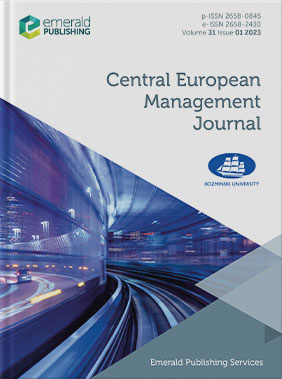
The Central European Management Journal is an academic, peer-reviewed journal covering all aspects of management in both public and private sector institutions. The journal is published by Emerald on behalf of Kozminski University.
eISSN: 2658-2430
You can publish an open access article in this diamond partnership journal. Authors in this journal are not required to pay an article processing charge (APC)



Journal Owners

Aims and scope
When submitting a manuscript, authors will be taken to a service called Paperpal Preflight, an AI-driven tool that checks manuscripts against the journal's author guidelines. Authors are free to use or bypass this step and submit directly to ScholarOne.
Central European Management Journal (CEMJ) publishes peer-reviewed research that focuses on all aspects of management, covering all from the nature of management itself to the impact management has within organisations. Articles may be interdisciplinary, as authors may base their studies of management within fields such as economics, law, psychology, literature, and sociology. CEMJ aims to, through its published research, facilitate a better understanding of both the essence of management and of research cooperation within the academic community, to thus have a positive influence on the world of management sciences.
The journal welcomes international submissions management that are theoretical and/or empirical in nature. The title covers but is not limited to the following areas of management:
- Human resource management
- Theory of organisation
- Psychology of management
- Gender in management and entrepreneurship
- Strategic management
- Corporate order
- Managerial economy
- Accounting
- Finance
- Leadership
IMPORTANT: It has been brought to our attention that the following website is posing as CEMJ: Submissions | CEMJP (cem-j.org). Please do not submit any articles to this website and do not pay any fees to the site. As of 2023, CEMJ is published by Emerald and, as such, this is the genuine website for the journal.
All articles published in CEMJ are published Open Access under a CCBY 4.0 licence.
The journal is published by Emerald on behalf of Kozminski University. The journal is owned by Kozminski University and is published under a diamond OA arrangement, in that all charges for publishing an OA article in the journal are funded by Kozminski University. There is no charge to the author.
Latest articles
These are the latest articles published in this journal (Last updated: April 2025)
Top downloaded articles
These are the most downloaded articles over the last 12 months for this journal (Last updated: April 2025)
Top cited
These are the top cited articles for this journal, from the last 12 months according to Crossref (Last updated: April 2025)

This title is aligned with our responsible management goal
We aim to champion researchers, practitioners, policymakers and organisations who share our goals of contributing to a more ethical, responsible and sustainable way of working.


Transparency statement for Central European Management Journal
- Journal Ownership: Central European Management Journal is published by Emerald Publishing on behalf of Kozminski University.
- Governing Body: The editorial team is appointed and managed by Kozminski University. The journal is governed by the editorial team in collaboration with Emerald Publishing.
- Peer Review Process: The journal operates a double-blind peer review model. All articles undergo an initial assessment by the journal editor. If they are considered suitable for consideration, articles will then be a reviewed by a minimum of two external reviewers to assess suitability for publication. Final responsibility for editorial decisions rests with the Editor-in-Chief of the journal.
- Editorial team/contact information: Contact details for the editorial team can be found on the journal homepage. Queries may also be directed to Emerald’s Publishing team as follows: Sophia Walton - [email protected]
- Copyright: All articles in the journal are published Open Access under a Creative Commons Attribution license (CC BY-4.0). This allows authors to retain copyright of their work whilst others can share, use and build upon this work created as long as appropriate attribution is given.
- Author Fees: The journal is published under a Diamond Open Access arrangement, in that all costs associated with publishing an Open Access article in the journal are funded by Kozminski University. There are currently no Article Processing Charges to the author(s).
- Allegations of Misconduct: All journals published by Emerald are members of and subscribe to the principles of the Committee on Publication Ethics. In the event of any allegation of research or publication misconduct the publisher and editor will adhere to COPE guidelines in dealing with such allegations.
- Conflicts of interest: Authors are asked to declare any financial or ethical conflicts of interest upon submitting their work to the journal. Difficult cases will be referred to the Committee on Publishing Ethics (COPE) for advice.
- Frequency: The journal publishes four issues per annum
- Access: All journal articles are published Open Access on EmeraldInsight.com - https://www.emeraldinsight.com/loi/cemj under a CCBY 4.0 licence (please see section 5).
- Revenue sources: The journal is published under a Diamond Open Access arrangement, in that all costs associated with publishing an Open Access article in the journal are funded by Kozminski University.
- Advertising: The journal does not accept direct advertising.
- Archiving: Emerald provides perpetual access for all e-journal content by working with digital preservation schemes Portico, LOCKSS and CLOCKSS.
- Direct marketing: On occasion the journal will use direct marketing activities (primarily email campaigns) to raise awareness of the journal and to invite authors to submit articles. Marketing activities are conducted by Kozminski University unless otherwise agreed with Emerald.
This statement was updated by Sophia Walton (Emerald Publishing Services) on 17 March 2026.
Related journals
This journal is part of our Business, management & strategy collection. Explore our Business, management & strategy subject area to find out more.
European Journal of Management Studies
The European Journal of Management Studies is an academic, peer-reviewed, open access journal focused on diffusion of...

European Journal of Management and Business Economics
The European Journal of Management and Business Economics is an academic, peer-reviewed journal focused on diffusion of...

LBS Journal of Management & Research
LBS Journal of Management & Research is bi-annual peer reviewed journal welcoming high-quality original contributions on...
