

Can we build a future we can't predict?
Rethinking infrastructure in an age of deep uncertainty

An Emerald mission in support of the UN Sustainable Development Goals
Share this content


From escalating climate risks to rapid technological disruption, from shifting demographics to political and economic volatility – uncertainty is the new normal. The built environment, traditionally designed for predictability and stability, is now being asked to do something new: absorb shocks, adapt to change, and evolve with the unknown.
Our cities, buildings, and infrastructure systems are increasingly vulnerable to unforeseen pressures – extreme weather events, resource shortages, public health crises, energy transitions, and social fragmentation. Conventional planning and engineering approaches, focused on efficiency and known risks, are ill-suited to this fast-evolving landscape.
But a shift is underway. Researchers and practitioners are embracing adaptive design, resilience thinking, scenario planning, and nature-based solutions to prepare infrastructure for multiple futures. This means building not just for durability, but for flexibility, redundancy, and responsiveness. The built environment is becoming a living system – one that must thrive amid uncertainty.
To help us address this, in our mission we ask:
- What does resilient, future-ready infrastructure look like in the face of deep uncertainty?
- How can we embed adaptability and foresight into design, planning and engineering of the built environment?
- What tools, data, and frameworks can help infrastructure respond dynamically to climate, societal, and technological change?
On this page
- Keynote blog: Framing the challenge: Rethinking how we plan for the future
- Free access to our related research
- Author insights
- Different routes to publication
- Additional information
- Talk to us about your work
- Mission-led research – our goals
We invite you to join the discussion. If you have related research or insights that begin to address these questions, or the broader challenges within this area, then we’d love to hear from you! Get in touch today.
This mission is aligned with our Sustainable structures and infrastructures goal
Keynote blog

Keynote blog by Goal Advisor - Professor Chimay Anumba, University of Florida, USA
Read this keynote blog as Professor Chimay Anumba sets the scene for the mission, exploring the question at its heart: how can we plan for a future we can’t predict?

Free access to our related research
Take a look at our journal articles and book chapters that explore this topic.

Author insights
Find out more about what our authors have to say on this topic.


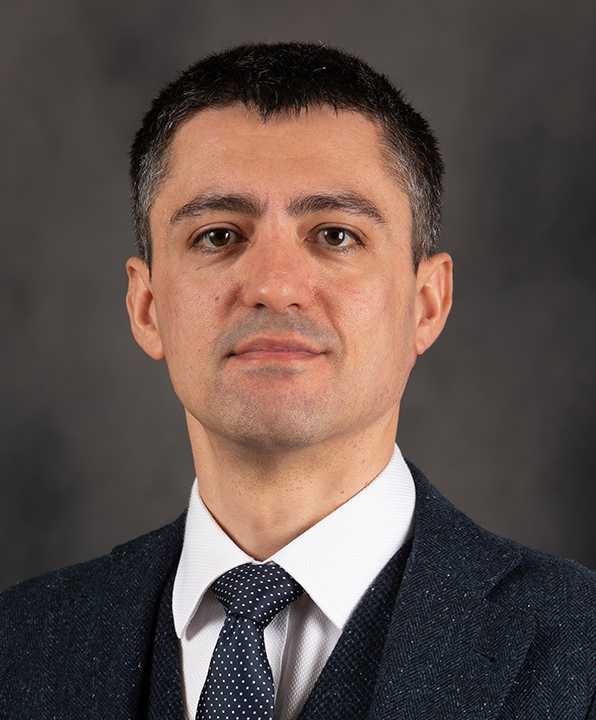







Addressing Climate Risk in Coastal Urban Areas of East and Southeast Asia
Author: Dr Bruce Chong, Fellow and Director (Climate & Sustainability), Arup, Hong Kong
Watch here as author Dr Bruce Chong shares insights into the introduction and methodology for his book that explores the challenges posed by climate hazards in coastal urban areas of East and Southeast Asia.
Book: Addressing Climate Risk in Coastal Urban Areas of East and Southeast Asia

Different routes to publication
Take a look at our calls for papers, books, special issues and featured journals that showcase further research and publishing opportunities within this area.


Featured journals
Here we have highlighted our key journals that publish research articles in this area. You can also search for a specific journal by subject area on our find a journal page.
If you want to speak to us about publishing an article in one of our journals, please get in touch.

Civil Engineering
Engineering Sustainability

Forensic Engineering
Infrastructure Asset Management
International Journal of Disaster Resilience in the Built Environment

Property Management
Smart and Sustainable Built Environment

Water Management
Geotechnical Engineering
Smart Infrastructure and Construction
Geotechnical Research
Additional information
Infrastructure climate change resilience
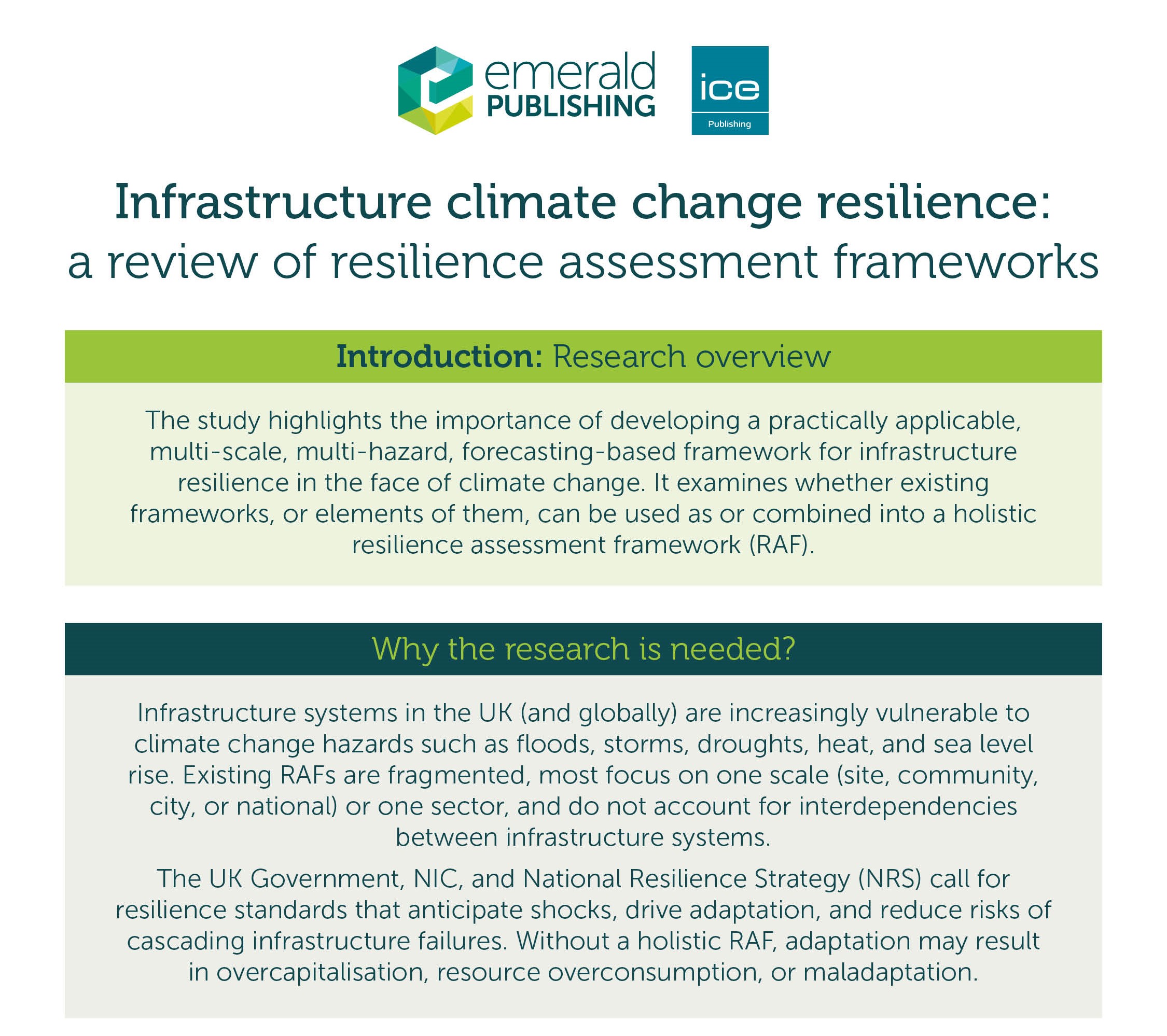
Take a look at this infographic that explores the importance of developing a practically applicable, multiscale, multi-hazard, forecasting-based framework for infrastructure resilience in the face of climate change. It examines whether existing frameworks, or elements of them, can be used as or combined into a holistic resilience assessment framework (RAF).
View the infographic to find out more
Article: Infrastructure climate change resilience: a review of resilience assessment frameworks
Journal: Engineering Sustainability
Infrastructure climate change resilience: a review of resilience assessment frameworks
Introduction: Research overview
The study highlights the importance of developing a practically applicable, multiscale, multi-hazard, forecasting-based framework for infrastructure resilience in the face of climate change. It examines whether existing frameworks, or elements of them, can be used as or combined into a holistic resilience assessment framework (RAF).
Why the research is needed?
Infrastructure systems in the UK (and globally) are increasingly vulnerable to climate change hazards such as floods, storms, droughts, heat, and sea level rise. Existing RAFs are fragmented, most focus on one scale (site, community, city, or national) or one sector, and do not account for interdependencies between infrastructure systems.
The UK Government, NIC, and National Resilience Strategy (NRS) call for resilience standards that anticipate shocks, drive adaptation, and reduce risks of cascading infrastructure failures. Without a holistic RAF, adaptation may result in overcapitalisation, resource overconsumption, or maladaptation.
Research questions
- Do any existing resilience frameworks, or components of them, meet the requirements set out by the NIC, MOD, and NRS for infrastructure climate change resilience?
- Can existing RAFs be combined or adapted into a holistic, practically applicable framework capable of crossscale, multi-hazard forecasting?
- What gaps in the literature and practice remain, and what components are available as building blocks for a new framework?
Methodology
Approach: Scoping review with Thematic Analysis.
Data sources: Academic databases (Google Scholar, Scopus), RAF taxonomies (Resilience Toolbox, Sustainable Infrastructure Tool Navigator), grey literature, and industry practice.
Inclusion criteria: RAFs addressing climate change-related hazards and resilience across economic, social, and environmental infrastructure.
Exclusion criteria: Frameworks unrelated to climate change (e.g., earthquakes, volcanic eruptions).
Analysis method: Thematic analysis to categorise RAFs into seven typologies (academic, government, NGO, industry standards, financial models, industry-led tools, international development tools).
Evaluation dimensions: Scale of application (national, city, community, site), hazard scope (single/multi-hazard), orientation (formative vs. summative), and whether frameworks assess resilience retrospectively (ex-ante) or forecast future resilience (ex-post).
Results
No existing framework meets the NIC’s requirements for a dynamic, multi-scale, multi-hazard, forecasting-based RAF.
110 frameworks were reviewed, and many valuable components were identified.
The research identified the following gaps:
- Lack of integration across scales (site, community, regional, national).
- Weak treatment of infrastructure interdependencies (“panarchy” issues).
- Heavy reliance on either theoretical academic models (hard to apply) or narrowly focused industry tools (too specific).
- No agreed benchmark or universal standard for resilience.
- Existing frameworks are often sector-specific, location-limited, or temporally static.
Conclusion
A holistic, dynamic, multi-scale, and forecasting-based resilience assessment framework does not yet exist, but components identified in current RAFs could serve as building blocks for developing such a tool, which is urgently needed to meet national and global climate resilience goals.
Infrastructure resilience under a changing climate
Take a look at this infographic that explores the challenges and progress in adapting to climate change, and the tools available for engineers to act, now, to enable infrastructure resilience for extreme weather that we experience now and in the future.
View the infographic to find out more
Article: Infrastructure resilience under a changing climate: the urgent need for engineers to act
Journal: Civil Engineering
Infrastructure resilience under a changing climate: the urgent need for engineers to act
Introduction: Research overview
This research explores the challenges and progress in adapting to climate change, and the tools available for engineers to act, now, to enable infrastructure resilience for extreme weather that we experience now and in the future.
Why the research is needed?
Our climate is changing, and infrastructure organisations must consider whether their infrastructure assets can operate in the different climate that we will experience in the future.
Climate projections show that the UK will have hotter drier summers, and milder wetter winters. Rainfall events are increasing in frequency and magnitude – i.e. more rain can fall in a shorter period, which can lead to flooding.
Infrastructure on or near the coast needs to prepare for higher sea levels and associated hazards such as flooding, erosion and storm surges.
Research questions
We put out a call for arms – engineers need to act now, to embed climate adaptation within their operations. It is also important that we teach engineers about climate change so they can design infrastructure for the future that supports decarbonisation and is ready for future weather.
Methodology
There are different tools to support climate adaptation. These include:
- Climate change risk assessments
- Developing adaption pathways to prepare for climate action
How is the research influencing change?
The University of Birmingham team continues to work on several exciting resilience projects, including:
- WM-Adapt A project working with the West Midlands Authority to deliver a step-change in adaptation across the region.
- Carmine: A project that’s developing climate-resilient development pathways in eight metropolitan case study areas across Europe, including Birmingham.
- Completing the infrastructure chapter of the 4th UK climate change risk assessment (CCRA4) technical report for the Climate Change Committee.
Talk to us about your work
We love hearing from researchers and practitioners about their work.
If you would like to contribute to the discussion, or have supporting research that addresses the challenges in this area, please let us know by filling in this form.





Share this content