

Bridging the age gap: What does the future hold for ageing workforces?

An Emerald mission in support of the UN Sustainable Development Goals
Share this content


Workforces across the globe are ageing at a pace that organisations, policies, and leadership models are struggling to keep up with. As people live and work longer, up to five generations may soon coexist in the same workplace, each shaped by different economic conditions, technologies, values, and expectations of work.
At the same time, rapid digital transformation and evolving labour markets risk marginalising older workers. Skills shortages, pension sustainability, age discrimination, and uneven access to lifelong learning are no longer future concerns, they are present-day realities reshaping productivity, wellbeing, and social cohesion.
Addressing the challenges of an ageing workforce is not simply about extending working lives. It requires rethinking how organisations design jobs, share knowledge, develop skills, and create inclusive cultures where age diversity and intergenerational collaboration can drive innovation, resilience, and fairness for the future of work.
This mission invites critical, forward-looking research that examines how organisations, leaders, and policymakers can respond to demographic change while building workplaces that confront age-related disparities and values contribution across the life course.
To help us address this, in our mission we ask:
- What happens to organisations when experience is undervalued and age is treated as a liability rather than an asset?
- Can intergenerational workforces genuinely collaborate, or will differences in values, digital fluency, and career expectations deepen divisions at work?
- If longer working lives become the norm, how must leadership, job design, and learning systems change to ensure work remains meaningful, healthy, and equitable for all ages?
On this page
- Free access to our related research
- Author insights
- Different routes to publication
- Talk to us about your work
- Mission-led research – our goals
We invite you to join the conversation to start unpacking the future of work for an ageing population. If you have related research or insights that begin to address these questions, or the broader challenges and opportunities of intergenerational workforces, then we’d love to hear from you. Get in touch today.
This mission is aligned with our Healthier lives goal

Free access to our related research
Take a look at our journal articles and book chapters that explore this topic.
Get access to our collections
To find out more about getting permanent access to Emerald collections, or to recommend our mission content to your librarian, get in touch here.
Author insights
Find out more about what our authors have to say on this topic.






The multilevel impact of age diversity on group and individual outcomes: role of social integration
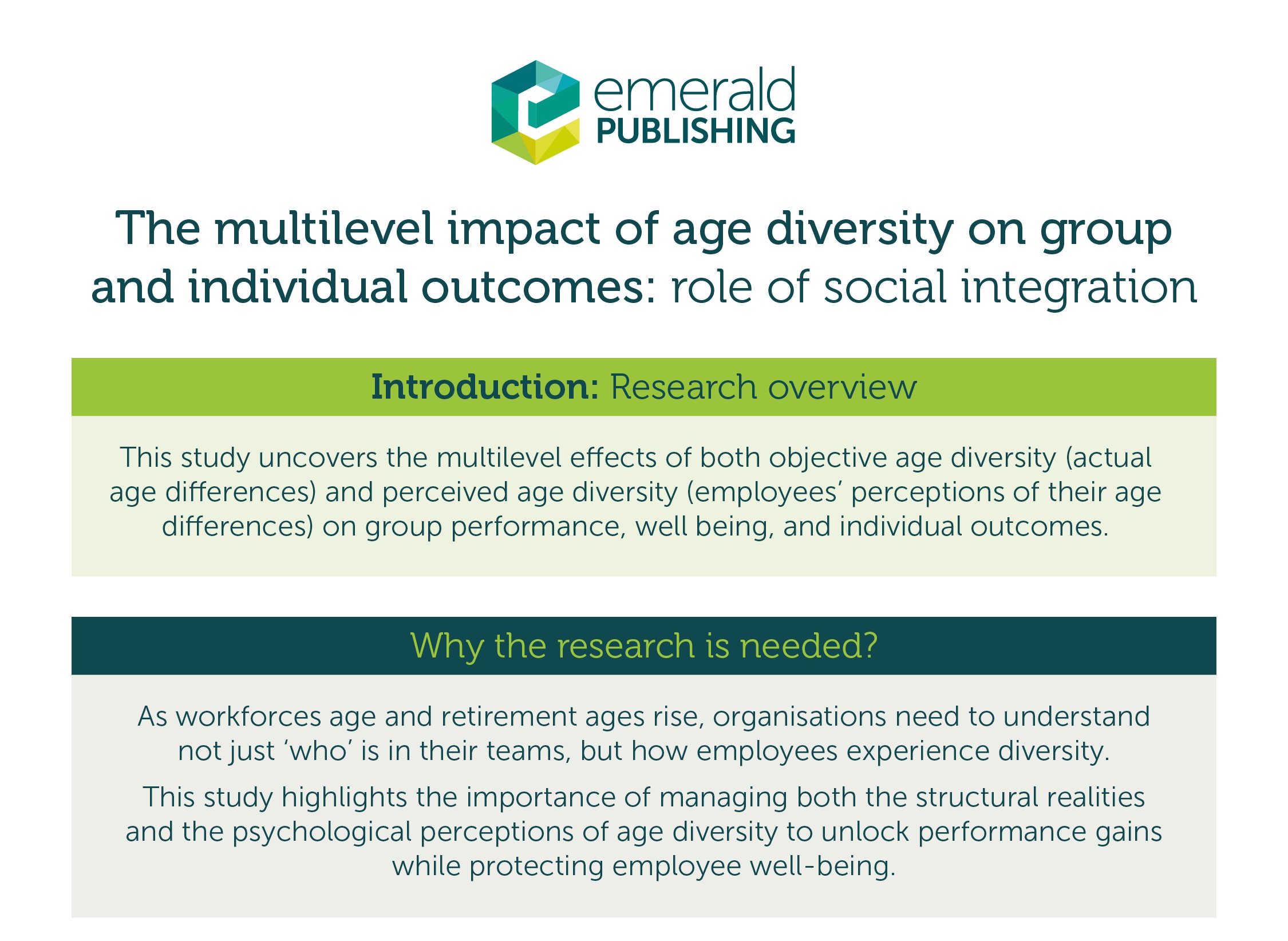
Take a look at this infographic that uncovers the multilevel effects of both objective age diversity (actual age differences) and perceived age diversity (employees’ perceptions of their age differences) on group performance, well being, and individual outcomes.
View the infographic to find out more
Article: The multilevel impact of age diversity on group and individual outcomes: role of social integration
Journal: Employee Relations
The multilevel impact of age diversity on group and individual outcomes: role of social integration
Introduction: Research overview
This study uncovers the multilevel effects of both objective age diversity (actual age differences) and perceived age diversity (employees’ perceptions of their age differences) on group performance, well being, and individual outcomes.
Why the research is needed?
As workforces age and retirement ages rise, organisations need to understand not just ‘who’ is in their teams, but how employees experience diversity.
This study highlights the importance of managing both the structural realities and the psychological perceptions of age diversity to unlock performance gains while protecting employee well‑being.
Research questions
How does age diversity really shape the way teams work?
Methodology
Drawing on data collected from a time-lagged survey of 305 employees and 78 leaders across two major banks, this research shows that age diversity is far from a simple story. Instead, diversity operates differently depending on whether we look at the group or individual level, and whether it is measured or perceived.
Results
The findings reveal the crucial role of ‘social integration’ in ensuring age-diverse teams thrive.
The study found:
- Objective age diversity boosts group well‑being, suggesting that real age differences can enrich team climate.
- Perceived age diversity enhances group performance, but it also reduces social integration. In turn, this increases employees’ intentions to turnover.
- Social integration emerges as a key mechanism. When employees feel connected, supported, and included, the benefits of diversity are amplified.
Conclusion
Age diversity can be a powerful asset, but only when organisations actively foster social integration. By paying attention to both objective and perceived diversity, leaders can create teams that perform better, feel better, and stay together longer.

Different routes to publication
Take a look at our different routes to publication that showcase further research and publishing opportunities within this area.

Featured journals
Here we have highlighted our key journals that publish research articles in this area. You can also search for a specific journal by subject area on our find a journal page.
If you want to speak to us about publishing an article in one of our journals, please get in touch.
Working with Older People

Personnel Review

International Journal of Manpower
Human Resource Management International Digest

International Journal of Organizational Analysis
Equality, Diversity and Inclusion: An International Journal
Development and Learning in Organizations: An International Journal
Employee Relations: The International Journal
Journal of Organizational Change Management
International Journal of Productivity and Performance Management

Journal of Workplace Learning

Journal of Managerial Psychology
Talk to us about your work
We love hearing from researchers and practitioners about their work.
If you would like to contribute to the discussion, or have supporting research that shares further insights into the themes and/or challenges in this area, please let us know by filling in this form.





Share this content