
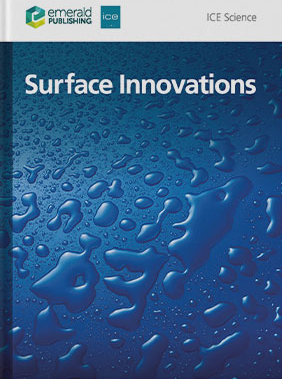
Types of submissions for Surface Innovations
The ICE Publishing electronic submission system accepts the following article categories for Surface Innovations:
- Invited Feature Articles
- Innovation Letters
- Original Research
- Expert Opinion
- Discussion Comments
- Themed Issue
Please visit https://ice-review.rivervalley.io/journal/jsuin to submit your paper.
Original Research (max. 5,000 words*)
An original report of primary research, detailing techniques and approaches and the work’s contribution to the field. There are two sub-categories of research articles: i) original scientific accounts that address problems and questions relevant to surfaces and interfaces; ii) original engineering innovations describing fabrication and characterization of novel, functional, and/or responsive surfaces.
Invited Feature Articles (max. 7,000 words)
State-of-the-art reviews with an up-to-date summary of knowledge on a particular subject or issue in the field of surfaces/interfaces and representing an overview of recent developments. These articles are written by experts in a field who have made important contributions to a specific topic in recent years who are invited by the Editor-in-Chief and/or Associate Editors.
Researchers who are not invited but are willing to prepare such a contribution are encouraged to email a one-page proposal for an Invited Feature Article to the Editor-in-Chief for consideration.
Innovation Letters (max. 3,000 words)
These are brief reports of significant, original and timely research results on the science and engineering of surfaces or interfaces, detailing preliminary results and warranting rapid publication. Also includes technical notes, relating to the latest technological, experimental or methodological developments within the authors field and should refer to the intended application. These letters will undergo a regular review process.
This category will also include:
Intriguing Innovation or Intriguing Phenomenon
Emphasizing papers that present intriguing observations and innovations, even if they are not complete pieces of scientific/engineering art and difficult to explain or implement.
Expert Opinion (max. 3,000 words)
Three types of contributions are considered: 1) Practical guides on experimental methods and protocols related to surface characterizations; and 2) Critical analysis of terminology used in surface/interfacial science; and 3) Critical analysis of research directions and interpretations in surface/interfacial science.
Through invited contributions, the journal offers scientific definitions combined with practical recommendations in an effort to combat misconceptions, abuses and misuses of surface chemistry terminology as well as growing misunderstanding and confusion among surface chemistry researchers working around the globe.
These articles are written by the Editorial Board members and other experts in a field who have made important contributions to a specific topic in recent years, and who are invited by the Editor-in-Chief and/or Associate Editors. These editors together with selected Editorial Board members will make a determination on fast publication of the opinion.
Researchers who are not invited but are willing to prepare such a contribution are encouraged to email a brief proposal for an Expert Opinion to the Editor-in-Chief for consideration.
Discussion comments (max. 1,000 words)
Brief responses to articles published in Surface Innovations. It should be a respectful presentation of alternative points of view, which also directs to errors in the published article(s).
The authors of the original Article will be offered the opportunity to submit a response.
Themed Issue (max. 6,000 words)
Only articles invited by the guest editors and editors of special issues can be submitted under this category.
* The word count exceeding this limit should be discussed with the journal editor.
Emerald’s Policy on AI Usage
Emerald’s overarching principles of AI usage:
1) Authors and peer reviewers are responsible and accountable for the accuracy and integrity of their work.
2) AI tools and technology must be used responsibly and transparently.
3) AI tools and technology should not replace human involvement in the publication process but instead supplement it.
Copywriting (creating, drafting, or writing) any part of a submission using generative AI tools and technology to generate new material is not permitted.
Copy-editing (correcting, editing, formatting, modifying, or refining) all or part of an author’s own original existing work using generative AI tools and technology the content to improve its structure and the clarity of the language and grammar is permitted, ensuring users adhere to the following overarching principles.
Emerald’s full policy, including examples of use cases can be found on our Publishing Ethics page.
-
Editor-in-Chief
-
Neil
Shirtcliffe
Rhine-Waal University of Applied Sciences - Germany
-
Neil
Shirtcliffe
-
Associate Editor
-
Ludmila
Boinovich
Frumkin Institute of Physical Chemistry and Electrochemistry - Russia
-
Sakil
Mahmud
Lincoln University - USA
-
Ludmila
Boinovich
-
Editorial Board
-
Alidad
Amirfazli
York University - Canada
-
Andrej
Atrens
University of Queensland - Australia
-
Ali
Atta
Jouf University - Saudi Arabia
-
Reza
Bakhsheshi-Rad
Islamic Azad University - Iran
-
Edward
Bormashenko
Ariel University - Israel
-
Emil
Chibowski
Maria Curie-Sklodowska University - Poland
-
Claudio
Della Volpe
University of Trento - Italy
-
Kirill
Efimenko
NC State University - USA
-
Alexandre M
Emelyanenko
Russian Academy of Sciences - Russia
-
Bora
Garipcan
Bogacizi University - Turkey
-
Yun Hang
Hu
Michigan Technological University - USA
-
Ahmad Fauzi
Ismail
Universiti Teknologi Malaysia
-
Mietek
Jaroniec
Kent State University - USA
-
Lei
Jiang
The Institute of Chemistry - P.R. China
-
Youhua
Jiang
Guangdong Technion-Israel Institute of Technology - P.R. China
-
Patricia
Jovicevic-Klug
Max Planck Institute for Sustainable Materials - Germany
-
Matic
Jovičević Klug
Max Planck Institute for Sustainable Materials - Germany
-
Ravi
Kumar
Indian Institute of Technology Madras - India
-
Ji
Liang
University of Wollongong - Australia
-
Abraham
Marmur
Technion – Israel Institute of Technology - Israel
-
Masoud
Mozafari
Iran University of Medical Sciences
-
Michael
Nosonovsky
University of Wisconsin - USA
-
Manoj
Prabhakar
Indian Institute of Technology Madras - India
-
Paul
Roach
Loughborough University - UK
-
Mohammed Reza
Saeb
Gdansk University of Technology - Poland
-
Nico
Voelcker
Monash University - Australia
-
Lei
Wang
Shanghai Institute of Technology - P.R. China
-
Piotr
Warszynski
J Haber Institute of Catalysis and Surface Chemistry - Poland
-
Lei
Zhang
University of Alaska - USA
-
Alidad
Amirfazli
-
Emeritus Editor-in-Chief
-
Jaroslaw
Drelich
Michigan Technological University - USA
-
Jaroslaw
Drelich
-
Commissioning Editor
-
Becky
Rivers
Emerald Publishing - UK
[email protected]
-
Becky
Rivers
-
Journal Editorial Office (For queries related to pre-acceptance)
-
Yash
Pandey
Emerald Publishing - India
[email protected]
-
Yash
Pandey
-
Supplier Project Manager (For queries related to post-acceptance)
-
Janhavi
Dalal
Emerald Publishing - India
[email protected]
-
Janhavi
Dalal
Citation metrics

6.2
CiteScore 2025
6.2
CiteScore 2025
4.1
CiteScore Tracker 2026
(updated monthly)
4.1
CiteScore Tracker 2026
(updated monthly)

3.5
2025 Impact Factor
3.5
2025 Impact Factor
2.9
5-year Impact Factor (2025)
2.9
5-year Impact Factor (2025)
Publication timeline
Time to first decision
25
days
Time to first decision
25
days
Acceptance to publication
24
days
Acceptance to publication
24
days
Acceptance rate
28
%
Acceptance rate
28
%
Indexing and metrics content displayed here
News
Surface Innovations - meet the new EiC!
I am Professor Neil Shirtcliffe and I am taking over from Professor Jaroslaw Drelich as Editor in Chief of Surface Innovations. Jarek was very successful in the role and it is going to be a challenge to follow in his footsteps....
Celebrating Award-Winning Papers in 2025
We’re proud to announce that a paper published in Surface Innovations has won a prestigious award from the Institution of Civil Engineers (ICE). This article was chosen by the journal Editor in Chief as the best from the previous Volume.&...
Novel research into improvements and applications of surfaces and surface coatings.
eISSN: 2050-6260






Aims and scope
The material innovations on surfaces, combined with understanding and manipulation of physics and chemistry of functional surfaces and coatings, have exploded in the past decade at an incredibly rapid pace.
Superhydrophobicity, superhydrophlicity, self-cleaning, self-healing, anti-fouling, anti-bacterial, etc., have become important fundamental topics of surface science research community driven by curiosity of physics, chemistry, and biology of interaction phenomenon at surfaces and their enormous potential in practical applications. Materials having controlled-functionality surfaces and coatings are important to the manufacturing of new products for environmental control, liquid manipulation, nanotechnological advances, biomedical engineering, pharmacy, biotechnology, and many others, and are part of the most promising technological innovations of the twenty-first century.
Awards: Each year, the paper rated best by the Editor will be given the prestigious Surface Innovations Prize.
Award-winning papers
Each year, we celebrate the best work published in our journals at the ICE Publishing Awards and make them free for you to read. We award authors from both industry and academia who have produced work judged by their peers to be of exceptional quality and benefit to the civil engineering, construction, and materials science community. Each paper is free to view for one year as part of our commitment to furthering knowledge and best practice.
| Year awarded | Paper title |
|---|---|
| 2025 | Effects of asymmetric cooling and surface wettability on the orientation of the freezing tip (Surface Innovations Prize) |
| 2024 | Antimicrobial performance of silver–copper–zeolite microparticle-treated organic cotton fabric using versatile methods (Surface Innovations Prize) |
| 2023 | Evolution of antibacterial and antibiofouling properties of sharkskin-patterned surfaces (Surface Innovations Prize) |

This title is aligned with our sustainable structures and infrastructures goal
We recognise the transformative power of sustainable engineering, design and building practices in creating a world where our planet and its inhabitants can thrive.


Related Journals
These journals are part of our ICE Science titles. Explore our ICE Publishing journals collection to find out more.
Green Materials
Papers on polymers and materials reducing the use of hazardous substances in products.
Bioinspired, Biomimetic and Nanobiomaterials
Papers on the promising area of research within biomimicry and nanobiomaterials.
Nanomaterials and Energy
Papers exploring the various aspects of nanomaterials and their applications in energy.
Emerging Materials Research
Covering materials process, structure, properties and performance at the macro micro and nanoscale.
Related Journals
Discover our ICE Publishing journals collection and Emerald Engineering subject area titles.
Green Materials
Papers on polymers and materials reducing the use of hazardous substances in products.
Bioinspired, Biomimetic and Nanobiomaterials
Papers on the promising area of research within biomimicry and nanobiomaterials.
Emerging Materials Research
Covering materials process, structure, properties and performance at the macro micro and nanoscale.
Nanomaterials and Energy
Papers exploring the various aspects of nanomaterials and their applications in energy.