

Education under threat:
Is innovation the key to resilience?

An Emerald mission in support of the UN Sustainable Development Goals
Share this content


Around the world, education systems are under mounting pressure. The escalation of political interventions has raised serious concerns about academic freedom, equitable access and institutional autonomy. From the defunding of federal education programs to the censorship of curricula and punitive measures against universities, the landscape is shifting rapidly. Globally, the picture is no less complex. The convergence of conflict, climate change, economic instability, and digital inequality threaten the very foundations of open, inclusive, and innovative education. In the face of these growing pressures, the question of resilience becomes urgent:
How can education systems not only survive but adapt and thrive?
Innovation is a vital force in reimagining how education can respond and adapt. From digital platforms that expand access to learning, inclusive pedagogy, and new models of collaboration, innovation is helping institutions and educators build systems that are more flexible, responsive, and future-ready. Unlocking creative solutions to complex challenges and ensuring that education can continue to serve as a stabilising force is imperative in these uncertain times.
Our mission explores how innovation can serve as a powerful tool to counter emerging threats and strengthen the resilience and equity of education systems worldwide.
To help us address this, in our mission we ask:
- What kinds of innovation are most urgently needed in education today?
- How can educators, researchers and policy makers foster innovation in education during times of crisis?
- How can innovation help protect academic freedom and institutional autonomy?
On this page
- Webinar
- Free access to our related research
- Author insights
- Different routes to publication
- Talk to us about your work
- #DefendResearch
- Mission-led research – our goals
We invite you to join the discussion. If you have related research or insights that begin to address these questions, or the broader challenges within this area, then we’d love to hear from you! Get in touch today.
This mission is aligned with our Quality education for all goal
Education under threat: Is innovation the key to resilience?
Watch the recording from our recent webinar in partnership with the Higher Education Teaching and Learning Association (HETL) as we’re joined by an expert panel to discuss how innovation can strengthen education systems and enable them to thrive during times of crisis and uncertainty.

Free access to our related research
Take a look at our journal articles and book chapters that explore this topic.

Author insights
Find out more about what our authors have to say on this topic.










Open innovation networks
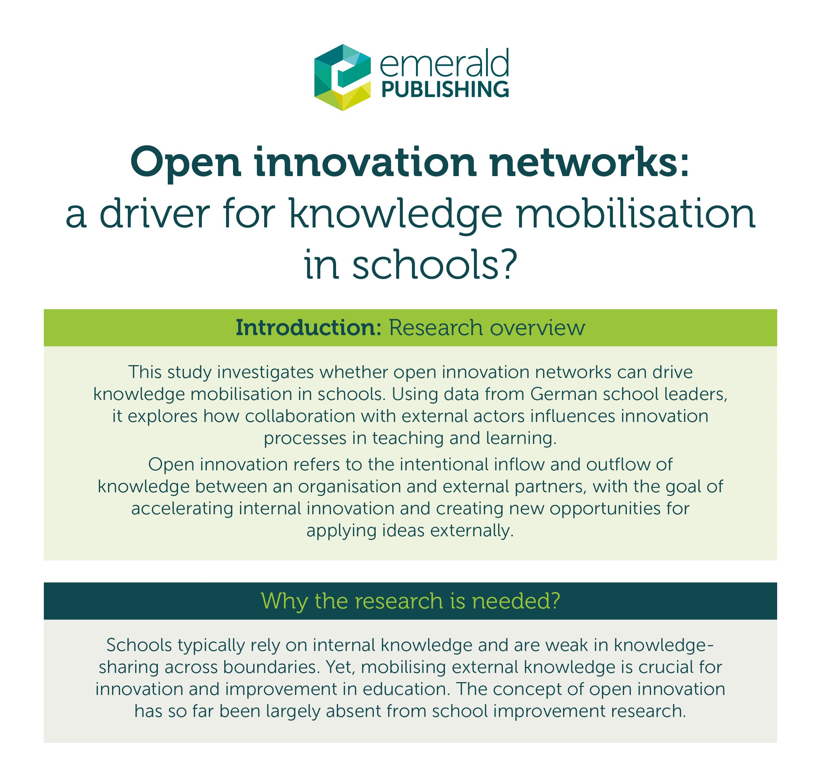
Take a look at this infographic that investigates whether open innovation networks can drive knowledge mobilisation in schools. Using data from German school leaders, it explores how collaboration with external actors influences innovation processes in teaching and learning.
View the infographic to find out more
Article: Open innovation networks: a driver for knowledge mobilisation in schools?
Journal: Journal of Professional Capital and Community
Open innovation networks: a driver for knowledge mobilisation in schools?
Introduction: Research overview
This study investigates whether open innovation networks can drive knowledge mobilisation in schools. Using data from German school leaders, it explores how collaboration with external actors influences innovation processes in teaching and learning.
Open innovation refers to the intentional inflow and outflow of knowledge between an organisation and external partners, with the goal of accelerating internal innovation and creating new opportunities for applying ideas externally.
Why the research is needed?
Schools typically rely on internal knowledge and are weak in knowledge sharing across boundaries. Yet, mobilising external knowledge is crucial for innovation and improvement in education. The concept of open innovation has so far been largely absent from school improvement research.
Research questions
- Can different innovation networks of schools be detected?
- Does the type of network depend on school characteristics?
- Do less networked schools rely more on internal (closed) innovation?
- Does network type influence knowledge mobilisation?
- Do school characteristics shape these effects?
Methodology
The study is based on data from 411 school leaders in Germany (nationally representative sample, LineS study, wave 3).
The survey followed the Oslo Guidelines for collecting and reporting innovation data (OECD/Eurostat, 2018) and applied the Copenhagen Manual for measuring public sector innovation (Co-PI, 2021).
School leaders reported on recent innovations, sources of knowledge, and external collaborations.
A latent class distal outcome model was used to identify different network types and their effects on open and closed innovation.
Results
Schools mainly use internal knowledge for innovation; external knowledge exchange is limited.
Four types of innovation networks were identified:
- Low cooperation
- System-oriented
- Science-oriented
- Market-oriented
Low cooperation schools relied heavily on internal knowledge.
Market-oriented schools (working with consultants and companies) accessed more diverse external knowledge.
Network effects did not depend on school size, type, or public/private status, though primary schools often benefited more from external cooperation.
Conclusion
Innovation networks have the potential to enhance knowledge mobilisation in schools, but stronger and more diverse collaborations with external partners are needed to unlock their full innovative capacity.

Different routes to publication
Take a look at our calls for papers, books and featured journals that showcase further research and publishing opportunities within this area.


Featured journals
Here we have highlighted our key journals that publish research articles in this area. You can also search for a specific journal by subject area on our find a journal page.
If you want to speak to us about publishing an article in one of our journals, please get in touch.

Quality Education for All

Learning Futures and Emerging Technologies

International Journal of Educational Management

Studies in Graduate and Postdoctoral Education

Journal of Applied Research in Higher Education

International Journal of Comparative Education and Development
Journal of Professional Capital and Community

Journal of Research in Innovative Teaching & Learning

Qualitative Research Journal

Foresight

Continuity & Resilience Review
Our new Open Access journal - Education Innovations: Systems and Future Learning
Joining our new collection of Gold Open Access journals, Education Innovations: Systems and Future Learning (EISFL) is dedicated to advancing interdisciplinary theories, multiple and sometimes contesting or complementary perspectives, empirical research, and critical analysis in educational development under the VUCA (Volatile, Uncertain, Complex, and Ambiguous) era.
The article processing charge (APC) will be waived for all manuscripts submitted before 31st December 2026.Find out more about the journal and submit your related research here
Talk to us about your work
We love hearing from researchers and practitioners about their work.
If you would like to contribute to the discussion, or have supporting research that shares further insights into the themes and/or challenges in this area, please let us know by filling in this form.

We stand in support of #DefendResearch
At a time of geopolitical instability, research and higher education are facing unprecedented challenges. Recent executive orders in the United States are disrupting research, education, and library programs resulting in cuts to funding in areas that need it most.
Having championed the democratisation of knowledge for well over 50 years, we don’t intend to stop. Academic freedom, without fear of suppression, is vital for societal progress.





Share this content