

Tech trends in healthcare:
better care or bigger risk?

An Emerald mission in support of the UN Sustainable Development Goals
Share this content


The global healthcare sector is undergoing a profound transformation as technological innovations become increasingly embedded in the practice, education, and governance of health services.
From Gen AI and blockchain to wearable devices and predictive algorithms, these advancements promise new efficiencies, greater access, and enhanced outcomes. However, they also present significant ethical, cultural, and education challenges – particularly in ensuring that such technologies are implemented safely, inclusively, and in ways that enhance rather than erode human-centred care.
In our mission we explore how advances in technology are reshaping the future of healthcare, the delivery of services and the preparation of its workforce, with a focus on the experience of health educators, practitioners, and students.
To help us address this, we ask:
- How are new technologies and the latest innovations being adopted to elevate the healthcare sector?
- What policies and procedures are needed to ensure the appropriate use of new technologies within healthcare?
- What measures should be taken to overcome the potential risks presented by the use of new technologies in health services?
On this page
- Free access to our related research
- Author insights
- Different routes to publication
- Additional information
- Talk to us about your work
- Mission-led research – our goals
We invite you to join the discussion. If you have related research or insights that begin to address these questions, or the broader themes within this area, then we’d love to hear from you! Get in touch today
This mission is aligned with our Healthier lives goal

Free access to our related research
Take a look at our journal articles and book chapters that explore this topic.
Author insights
Find out more about what our authors have to say on this topic.


Different routes to publication
Take a look at our call for papers, special issues, books and featured journals that showcase further research and publishing opportunities within the area of technology in healthcare.


Featured journals
Here we have highlighted our key journals that publish research articles in this area. You can also search for a specific journal by subject area on our find a journal page.
If you want to speak to us about publishing an article in one of our journals, please get in touch.

Journal of Integrated Care

Journal of Health Organization and Management

International Journal of Health Governance

Journal of Enabling Technologies

Mental Health and Social Inclusion

Mental Health and Digital Technologies
International Journal of Health Care Quality Assurance

Technological Sustainability

European Journal of Innovation Management

Benchmarking: An International Journal

The International Journal of Logistics Management

Business Process Management Journal
The TQM Journal

International Journal of Quality & Reliability Management

International Journal of Ethics and Systems

Journal of Humanitarian Logistics and Supply Chain Management

Additional information
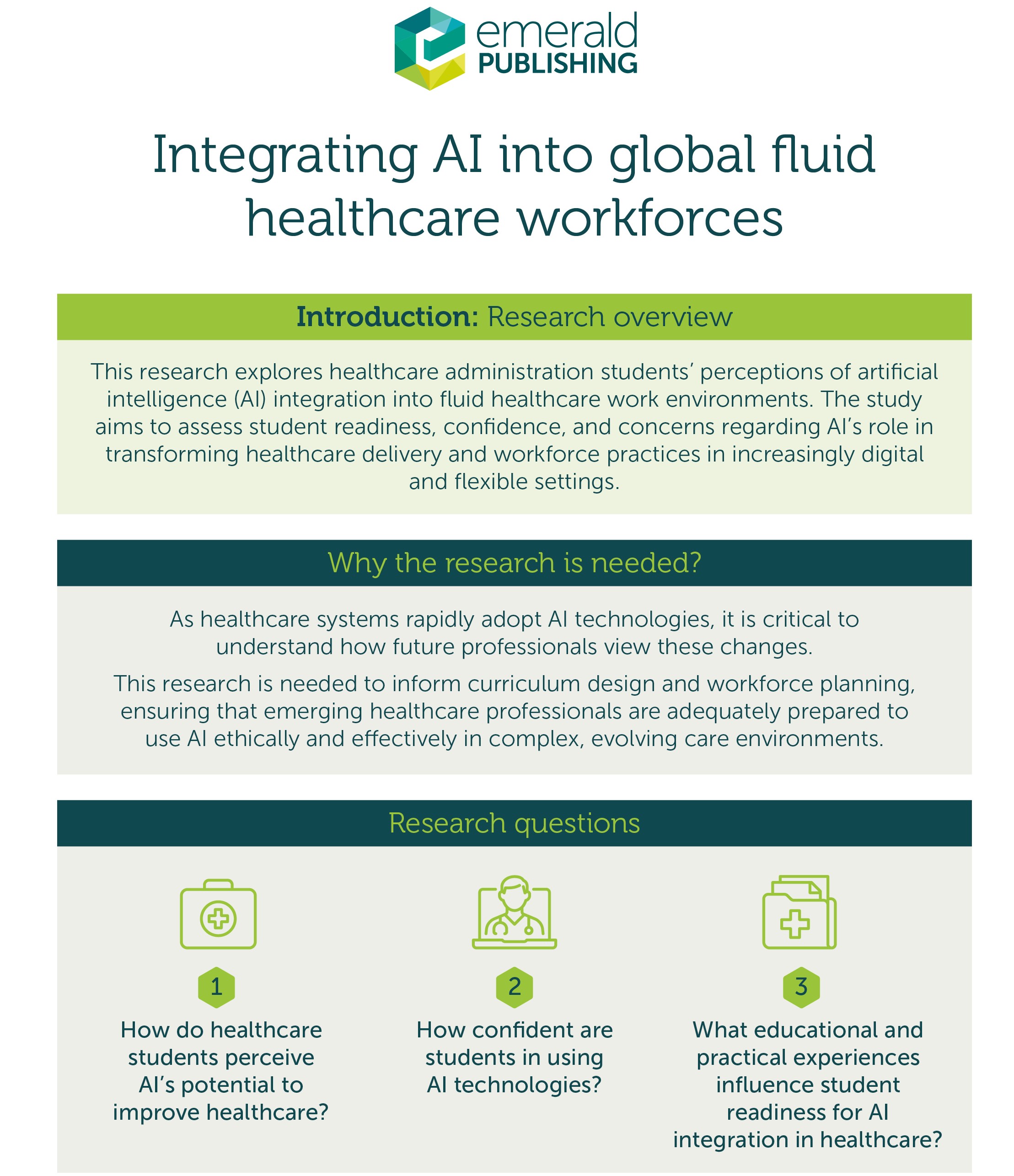
Integrating AI into global fluid healthcare workforces
Take a look at this infographic that explores healthcare administration students’ perceptions of artificial intelligence (AI) integration into fluid healthcare work environments. The study aims to assess student readiness, confidence, and concerns regarding AI’s role in transforming healthcare delivery and workforce practices in increasingly digital and flexible settings.
View the infographic to find out more
Article: Integrating AI into global fluid healthcare workforces: student perspectives and future trends
Journal: International Journal of Productivity and Performance Management
Integrating AI into global fluid healthcare workforces
Introduction: Research overview
This research explores healthcare administration students’ perceptions of artificial intelligence (AI) integration into fluid healthcare work environments. The study aims to assess student readiness, confidence, and concerns regarding AI’s role in transforming healthcare delivery and workforce practices in increasingly digital and flexible settings.
Why the research is needed?
As healthcare systems rapidly adopt AI technologies, it is critical to understand how future professionals view these changes.
This research is needed to inform curriculum design and workforce planning, ensuring that emerging healthcare professionals are adequately prepared to use AI ethically and effectively in complex, evolving care environments.
Research questions
1) How do healthcare students perceive AI’s potential to improve healthcare?
2) How confident are students in using AI technologies?
3) What educational and practical experiences influence student readiness for AI integration in healthcare?
Methodology
Using a mixed-methods approach, the study surveyed 62 undergraduate healthcare administration students at a mid-sized urban university.
The anonymous online survey included 27 items exploring AI:
- Understanding
- Confidence
- Perceived importance of AI applications
- Demographic factors
Results
Students expressed a generally positive view of AI’s role in improving healthcare operations, especially in areas like diagnostics and workflow efficiency.
Academic level and internship experience were significantly associated with AI confidence.
However, students raised concerns about:
- Job security
- Depersonalised care
- As a result, pointing to the need for more hands-on, ethically grounded AI education.
Conclusion
Preparing a healthcare workforce that is confident, ethically grounded, and practically trained in AI technologies is essential to ensuring that digital transformation in healthcare leads to improved outcomes without compromising human-centred care.
Talk to us about your work
We love hearing from researchers and practitioners about their work.
If you would like to contribute to the discussion, or have supporting research that shares further insights into the themes and/or challenges in this area, please let us know by filling in this form.





Share this content