

Interview with 2025 ICE Award winners for Water Management
In celebration of the 2025 ICE Robert Alfred Carr Prize which recognises the best paper published in Water Management in 2024, we are delighted to present an interview with the authors of the winning article, Machine learning-based prediction of scour depth around different-shaped bridge abutments. This study, led by researchers from Dalian University of Technology, China, showcases the power of machine learning in advancing hydraulic engineering.
In this interview, the authors share the inspiration behind their work, the challenges they overcame, and the practical implications of their findings for bridge design and safety.
Mr Yangyu Deng, Professor Yakun Liu, Professor Di Zhang, Professor Ze Cao, congratulations on your recent award! You are the recipients of 2024 Water Management Best Paper for article ‘Machine learning-based prediction of scour depth around different-shaped bridge abutments’. Could you briefly introduce yourself and your background to our readers?
Thank you very much for this opportunity. It is a great honor to receive the 2024 Water Management Best Paper Award. This acknowledgment inspires us to keep exploring and innovating in hydraulic engineering.
Mr Yangyu Deng, a PhD student at Dalian University of Technology, has an academic background in hydraulic engineering and machine learning, whose research interests lie in parameter prediction and intelligent surrogate models for engineering systems.
Professor Yakun Liu, a Senior Professor at Dalian University of Technology, brings a strong academic background in physical experiment, numerical simulation and artificial intelligence for hydraulic engineering, who has a deep insight in uncovering the fluid mechanics underlying various engineering problems, as well as in the design and optimization of the related intelligent models.
Professor Di Zhang, an Associate Professor at Dalian University of Technology, highly specializes in computational mechanics, hydraulic engineering and ecological engineering, with particular strengths in the design of numerical algorithms, hydraulic analysis of engineering problems, morphological optimization of fishways.
Professor Ze Cao, an Associate Professor at Dalian University of Technology, has a background in both sediment erosion and computational mechanics and specializes in addressing sediment scour with Lagrangian approaches.
What inspired you to explore machine learning techniques for predicting scour depth around bridge abutments? What key question were you aiming to answer with your research?
The motivation to apply machine learning for predicting scour depth around bridge abutments stems from the complexity and variability of hydraulic processes near hydraulic structures. Traditional empirical methods often struggle to accurately capture the nonlinear interactions among flow velocity, sediment characteristics, and structural geometry. Machine learning offers a flexible data-driven framework that can learn these complex relationships from experimental data, providing faster and potentially more accurate predictions of scour depth.
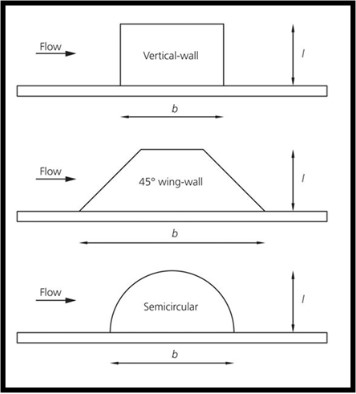
Figure 1. Schematic plot of bridge abutments with different shapes (b is the streamwise length of abutments and l is the transverse length of abutments)
The key question we aimed to answer in our research was: how can we accurately predict scour depth around bridge abutments under varying hydraulic conditions using data-driven approaches? Traditional methods often rely on simplified assumptions and empirical formulas, which may not capture the complex interactions among flow, sediment, and structural geometry. Our work explores whether machine learning models can effectively learn these nonlinear relationships to provide reliable predictions for engineering design and risk assessment.
Your study compares several machine learning models. Can you briefly explain why multigene genetic programming (MGGP) stood out as the most effective?
MGGP stands out as the most effective among the models we tested because it combines the strengths of genetic programming with a multigene structure. Each gene captures different nonlinear relationships in the data, and the combination allows the model to flexibly approximate complex interactions between flow conditions, sediment properties, and structural geometry. In contrast, while M5′ Model Tree (M5′MT), Multivariate Adaptive Regression Spline (MARS), and Locally Weighted Polynomial Regression (LWPR) can model nonlinearities, they are limited in capturing highly intricate relationships simultaneously. MGGP’s ability to evolve both the structure and coefficients of multiple genes gives it superior predictive performance in predicting scour depth around bridge abutments.
What were some of the biggest challenges you faced during the research process, and how did you overcome them?
One of the major challenges in this research was accurately predicting scour depth for different types of bridge abutments, including vertical-wall, 45° wing-wall, and semicircular shapes, which makes it challenging for a single model to generalize across all configurations. To address this, we first conducted correlation and sensitivity analyses to identify the optimal combination of input parameters for each model. Then, we implemented multiple machine learning models to compare their performance, and this systematic approach allowed us to select MGGP as the most effective model overall, providing both high accuracy and interpretability.
How do you see your findings influencing real-world engineering practices, particularly in bridge design and safety?
Our findings offer a more accurate and reliable approach to predicting scour depth around different types of bridge abutments. By using MGGP and other machine learning models, researchers and engineers can better capture the interactions between flow and sediment for vertical-wall, 45° wing-wall, and semicircular abutments. This improved prediction supports safer and more efficient bridge designs, optimizes the sizing and reinforcement of abutments, and helps prevent failures due to unexpected scour. Ultimately, it enhances both the safety and longevity of bridge structures while potentially reducing unnecessary construction costs.
Machine learning is evolving rapidly. What future directions do you envision for its application in hydraulic engineering?
We believe that machine learning in hydraulic engineering will increasingly evolve toward physics-informed approaches that integrate data with governing equations, thereby enhancing model generalizability and physical consistency. In addition, its applications in real-time monitoring and digital twin frameworks will likely provide transformative tools for advancing predictive capability, risk assessment, and sustainable water management.
What motivated you to ICE Publishing/Emerald and Water Management as the journal for this work, and how do you see the journal’s role in advancing innovation in management of water in natural and engineered systems?
Water Management provides a well-recognized platform for bridging research and practice, particularly for studies addressing both natural and engineered water systems. The journal’s emphasis on innovation and practical relevance makes it an ideal outlet for disseminating research findings to a broad audience of researchers and practitioners. ICE Publishing/Emerald has a strong reputation in hydraulic and civil engineering and provides access to an international community of experts.
Collaboration is key in research. Could you share how your team worked together and what each member brought to the project?
Collaboration was essential for this research. One team member focused on collecting and analyzing experimental data on bridge abutment scour. Another developed and optimized the machine learning models. A third member focused on creating figures and drafting the manuscript. The last member revised the manuscript. This division of labor allowed us to effectively evaluate multiple models, identify key input parameters, and ultimately recommended MGGP as the most reliable model across different abutment types.
What advice would you give to early-career researchers or students hoping to make a meaningful impact in academia and looking to publish impactful work in journals like Water Management?
Our advice would be to stay curious and persistent. Focus on understanding the underlying principles of physical phenomena. Collaborate actively with others to gain diverse perspectives, and remain open to learning emerging technologies. When publishing research, it is important to communicate findings clearly. Clarity often makes research both impactful and widely recognized.
******
Professor Mr Yangyu Deng, Professor Yakun Liu, Professor Di Zhang, Professor Ze Cao‘s award winning article, 'Machine learning-based prediction of scour depth around different-shaped bridge abutments' published in Volume 177, Issue 5 (October 2024) of Water Management, will be free to read for a year. All Water Management issues are available on Emerald Insight .
For more awards on related engineering subjects, please visit ICE Publishing Awards.