

Meet the 2024 ICE Award winner for Géotechnique - Telford Gold Medal
We are delighted to feature an interview with the winner of the 2024 Telford Gold Medal. In this brief conversation, the author shares insights into their award-winning work, the motivation behind it, and their experience publishing with ICE Publishing/Emerald.
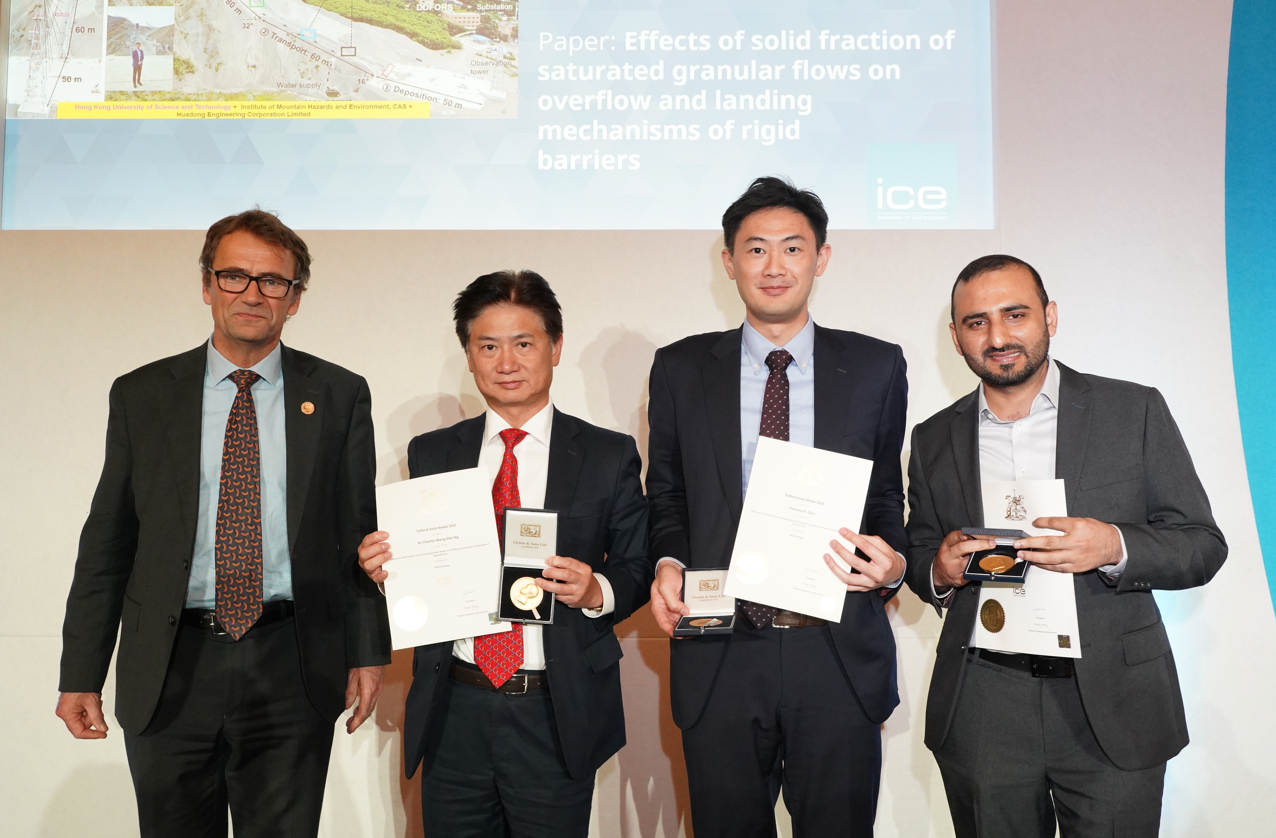
The authors receiving their Medals from ICE President Jim Hall
Question 1: Professor Ng congratulations on your recent award! You are the recipient of 2024 Telford Gold Medal for article ‘Effects of solid fraction of saturated granular flows on overflow and landing mechanisms of rigid barriers’. Could you briefly introduce yourself and your background for our readers?
Answer: Professor Charles Wang-Wai Ng is the Vice-President for Institutional Advancement. He also serves as the CLP Holdings Professor of Sustainability, Chair Professor in the Department of Civil and Environmental Engineering, and Director of the State Key Laboratory of Climate Resilience for Coastal Cities. He is a Fellow of Royal Academy of Engineering.
Clarence E. Choi is Associate Professor in the Department of Civil Engineering at the University of Hong Kong. His current research interests are on engineered and nature-based solutions against landslide hazards and decarbonization in ground improvement. He earned his PhD from HKUST under the supervision of Prof. Charles W.W. Ng.
Usman Majeed is a Geotechnical Engineer at Arup, holding a PhD in Civil Engineering from HKUST under the supervision of Prof. Charles W. W. Ng. His PhD work focusses on the physical and numerical modelling of flow–barrier interactions for multiple barrier design systems, contributing to the understanding of geotechnical resilience and hazard mitigation.
Question 2: What inspired the research behind your award-winning paper, and what key question were you aiming to answer?
Answer: The research work is part of two large-scale research projects led by Professor Charles W.W. Ng and funded by the Research Grants Council of Hong Kong. Specifically, a Theme-based Research Scheme project entitled, “Understanding debris flow mechanisms and mitigating risks for a sustainable Hong Kong” and (2016-2020; about GBP3.3M) and an Areas of Excellence project entitled “Centre for Slope Safety” (2019-2027; about GBP9.2M). Both projects strive to advance landslide hazard mitigation technology to protect mountainous communities globally. Clarence and Usman participated in these two projects and were supervised by Prof. Ng at the time.
One of the theories and technologies developed from these two projects are multiple resisting barrier systems, which enable large volumes of debris to be arrested using multiple small barriers to enhance sustainability and safety. The fundamental question we answered is how to space these rigid barriers for optimal performance in terms of impact force and volume retained? In the award-winning paper, we conducted a series of lab-scale flume experiments to answer the research question. The experiments modelled flows with different proportions of solid to fluid fractions to understand how they impact, overflow and land between two rigid barriers installed in series. As a result of our research, we offer an enhanced solution compared to existing design guidelines worldwide to recommended new design criteria including impact force and landing distance that consider overflow and retained volume. Our findings help to safely space multiple rigid barriers in series to resist a wide range of debris flows types with different solid fractions.
Question 3: Were there any unexpected challenges or discoveries during your research process?
Answer: The most unexpected challenge faced during the research process was determining how to scale the overflow and landing dynamics between solid-fluid mixtures and barriers. As mentioned, this award-winning paper was only a small part of two large-scale research projects. We spent over a decade developing and fine-tuning scaling relationships for flow-barrier interaction through multi-scale modelling in the geotechnical centrifuge, lab-scale flume models, and field-scale flume models. Only for this award-winning paper, instead of impact, we examined the mechanisms of overflow and landing. It was truly remarkable that we were able to unify the overflow and landing processes of debris flow impact using a new dimensionless parameter called the barrier Froude number. This discovery helps to streamline design because the proposed parameter is easy to obtain for practical engineering design.
Question 4: How do you envision your findings influencing future research or real-world applications?
Answer: Our findings really have broad implications for debris flow management around the world. While our research is grounded in the context of Hong Kong, the principles can be applied to regions like mainland Austria, Brazil, China, New Zealand, Italy, Switzerland, United States, and Japan—places facing similar debris flow hazards. Many of these countries have their own national organizations dedicated to hazard assessment and mitigation. For instance, in the U.S., the Federal Highway Administration (FHWA) provides guidance on debris flow barriers, focusing on factors like debris volume and velocity to inform barrier design. Japan’s Land and Infrastructure Management Institute and China’s Geological Survey also have their own standards, but most of these guidelines tend to focus heavily on retained volume when it comes to barrier spacing.
What our research adds is a new perspective: considering the barrier Froude number—aiming for a value around one—can lead to more accurate and reliable designs. Instead of just looking at how much debris the barrier can hold, we’re also factoring in flow dynamics, overflow distances, and the physics of debris movement. This science-based approach can help optimize barrier placement, making them more effective, environmentally friendly, and cost-efficient, with less ongoing maintenance.
Overall, our work offers a sort of universal framework that can be adapted to different geographic and infrastructural contexts. It’s about improving safety and resilience, helping communities better protect themselves against debris flows in a way that’s grounded in solid science and sustainable practice.
Question 5: What motivated you to choose ICE Publishing/Emerald and Géotechnique as the platform for sharing your research?
Answer: Géotechnique is undoubtedly the top journal in the geotechnical engineering field, thanks to its rigorous peer-review process and its emphasis on high-quality, technically sound publications. The journal’s reputation for publishing impactful research aligned well with our goal of contributing meaningful insights into flow dynamics and barrier design. With the well-established reputation of ICE Publishing/Emerald—and Géotechnique in particular—sharing our findings through this platform ensures they reach a technically engaged audience capable of building upon them in both academic and applied contexts.
Question 6: What are the next steps in your research? Are there any emerging areas or interdisciplinary connections you are excited to explore?
Answer: Recently, HKUST and the Institute of Mountain Hazards and Environment of the Chinese Academy of Sciences collaboratively constructed the world’s largest flume testing facility. The flume is more than 190 m in length and 6 m in width. The facility can release up to 500 m3 of debris down a channel to further validate our proposed design recommendations at engineering scale. Furthermore, not only do we study rigid barriers, but we are also exploring the use of multiple flexible steel net barriers, including our own in-house designed barrier. Flexible barriers can deform upon impact and reduce the need to large foundations. Furthermore, flexible barriers blend in well with natural surroundings making them a greener solution. A new paper has been submitted to Géotechnique for review recently.
Question 7: What advice would you give to early-career researchers or students hoping to make a meaningful impact in academia?
Answer: We would advise early-career researchers and students to identify key and impactful scientific challenges, analyse and tackle them.
Thank you for sharing your insights, and congratulations once again on this well-deserved recognition!
Effects of solid fraction of saturated granular flows on overflow and landing mechanisms of rigid barriers is published in Volume 74, Issue 1 (January 2024) of Géotechnique, and will be free to read for a year.
For more awards on related engineering subjects, please visit ICE Publishing Awards.