

Empowering female climate change activists podcast
Share this content


In a world increasingly affected by climate change, the resilience and leadership of women in the Global South are more critical than ever. Our latest podcast explores the dynamic intersection of female empowerment and environmental sustainability, revealing how empowering women can drive transformative social change.
Our guest is Dr Peg Spitzer, author of ‘Empowering Female Climate Change Activists in the Global South: The Path Toward Environmental Social Justice’. Peg has dedicated her career to understanding and amplifying the voices of women in the Global South. With vivid personal stories and extensive field search, she illustrates the resilience and ingenuity of women farmers facing climate-related challenges.
In this episode, you will hear about inspiring stories from diverse regions, including Africa, Central America, and South and Southeast Asia. We will explore how women are overcoming patriarchal constraints to lead eco-friendly initiatives and transform their communities. By tuning in, you'll gain insights into the practical strategies these women employ, the systemic challenges they confront, and the incredible potential they have to foster sustainable development. In addition, you’ll hear reflections from Jamie Sommer (University of South Florida), Susan Hinely (Stony Brook University), Ayuska Motha (Federation of American Women’s Club Overseas), Laura Sabater (Gender Environmental Data Alliance), and Vicky Bush Joseph (Together Women Rise). Join us to be part of a critical conversation about climate justice, female empowerment, and how each of us can contribute to a better world.
Empowering Female Climate Change Activists in the Global South is free to access on Emerald Insight.
Further work
Listeners can learn more about one of Peg’s digital projects from Stony Brook University Libraries Collection here.
Prompted by the book, Peg has launched a nonprofit organisation called the Climate Knowledge Collective. Its mission is to preserve and shares stories of environmental resilience and innovation, with a focus on feminist knowledge.
Peg and her team would be delighted to learn about other projects and conduct more interviews to add to the digital collection of oral histories.
Speaker profile(s)
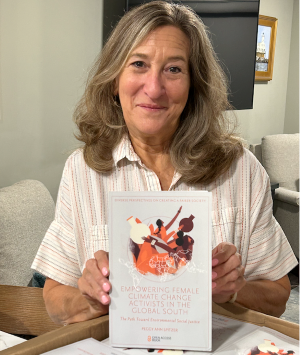 Dr Peggy Ann Spitzer is a Research Professor in the College of Arts and Sciences at the State University of New York at Stony Brook. She holds a bachelor’s degree from the University of Minnesota and master’s and doctoral degrees from American University in Washington, DC – all in International Relations. She studies women’s leadership in global climate change adaptation through environmental and gender equity strategies and oral histories.
Find Dr Peggy Ann Spitzer via LinkedIn and email.
Podcast Host

Rebecca Torr is the Publishing Development Manager for Sustainable Structures and Infrastructures and works with authors and organisations in engineering subjects such as civil engineering and materials science to further the impact of research in the real world. As part of her hosting role on the Emerald Podcast Series, Rebecca interviews experts who use research to create real impact.
In this episode:
- Why focus on female climate change activists in the Global South?
- What unique challenges and opportunities do women in these regions face?
- In what ways do patriarchal systems hinder or support climate change activism?
- What role do oral histories play in understanding women's contributions?
- How are women-led initiatives driving social and environmental change?
Transcript
Empowering female climate change activists
Rebecca Torr (RT): Hi, I’m Rebecca Torr and welcome to the Emerald Podcast Series. Today's episode focuses on climate change and female empowerment. We're thrilled to have with us Peg Spitzer, a Research Professor in the College of Arts and Sciences at the State University of New York at Stony Brook and the author of ‘Empowering Female Climate Change Activists in the Global South.’
We’ll uncover the challenges and triumphs of female activists in the Global South and discuss how their efforts are crucial for achieving environmental social justice. Peg’s book is a call to action, urging us to listen to and amplify the voices of women who are at the forefront of climate resilience. Through a series of compelling interviews and case studies, she highlights the intersectional issues that women face and how they’re creating innovative solutions to address the climate crisis. Join us as we explore the narratives that shape our understanding of climate activism through a feminist lens and discuss how this approach can lead to real change.
Peg Spitzer (PS): Climate change seems overwhelming, doesn't it? It's, you know, how do you even address it. But I hope that my book sparks ideas and demonstrates that female empowerment in local communities in the Global South is important for the world. And that's a really good place to start. In fact, I think, you know, even though I've conducted so many interviews, I really believe that my book only scratches the surface. And I hope that it will inspire others to learn about women and girls in their communities, and how to address challenges posed by these weather related disasters that we are just continuing to see evolve over time.
RT: I mean, climate change, it just affects everyone. It's global. It's an issue that no one can avoid. And, you know, I think it's really interesting, interesting perspective that you've, you've the way you've approached this is an interesting perspective, because you've obviously looked at females and the female activists that are in the Global South, and I would just, you know, how, yeah, really wants to understand why you focused on females, and also why the Global South, and what can we learn from this group, I suppose this focus group that you've looked at?
PS: Yes, that's really, really a very important part of the book, because I really focus on about 12 case studies of of the female activists, and the reason I focused on them is because I realised that women's efforts and contributions to their communities were not clearly understood. And so to do a deep dive into these, it's very important to underline for our listeners, I'm bringing into account our conversation today, a few voices of scholars and activists that are integrally involved in helping me bring to light these stories. First, to answer your particular question is Jamie Sommer, who is a professor of sociology at the University of South Florida. And Jamie worked with me on interviewing farmers in India, about a women led irrigation technology. So here is how she explains why she feels that women's contributions have been ignored.
Jamie Sommer: The current flavor of the global dominant male centered paradigm can be traced back to a European Aristotelian based Christian context that reifies its power through exclusionism, and othering. The process by which we make each other seem so different, that we drive ourselves apart, we become us and they become them. From this backdrop, women and other genders are feared as others and conquered, just like how man conquered nature and the environment. That's how patriarchal structures contribute to climate change. When we organise society in a way that privileges a mostly male or men's perspective and power, while also devaluing contributions from other genders, we are also strengthening a system that others the natural environment, seeing it as resources to be used, rather than an integral part of who we are.
PS: So as Jamie has noted, these particular patriarchal structures haven't really allowed us to accept or acknowledge or benefit really from the ways women and others or as others really adapt to weather related disasters. So to address this, and the point of my book, is that we must make a concerted effort to listen to women's voices and their experiences.
RT: It's a really interesting point, isn't it? I think that, you know, having the perspective from women, and you know, what's really missing in lots of the narratives that are out there about climate change, and, and sort of why we've got ourselves into this mess, you know, why is it so bad as it is? And sort of what role can females play? And what role are they playing in making a difference? And so, obviously, you said that you examine how patriarchal structures contribute to climate change. And maybe you can tell us a bit more about that. And have you come to any conclusions in your, in your book about how they can be addressed as well? I mean, can we change? I mean, these, obviously, these practices and the ways of life have just gone on for centuries and centuries. I mean, is there anything that can be done?
PS: Well, it's going to take a lot of work. And the first part is really awareness and recognition of what, what is happening on the ground. Because I think that's a key and I'm going to talk about this a little bit more. But it seems just to provide a little bit of perspective, throughout history, women have had a vital role in agriculture. And I think that's key to understand. Another one of my colleagues, a scholar activist who is now in Senegal as we speak, learning about women fishers in the Saloum, Delta region. Her name is Susan Hinley. Talked to me about the way agriculture has been feminised. And in this short clip that I'm going to play for you, she makes a case for why the status quo patriarchy must change.
Susan Hinley: While it is often overlooked, the historical record clearly shows the importance of women's work and knowledge, not only in primary food production, but also in stewardship of the earth and its resources. Women were the first cultivators, Neolithic women basically invented agriculture. And with the onset of modernity, women's importance to food production only increased as men left the countryside to work for wages, a feminisation of agriculture that is accelerated globally in the 20th and 21st centuries. For millennia, women have practiced the kind of collective time consuming, but also regenerative forms of food production, that are increasingly looked to as alternatives to the large scale commercial operations that depend on fossil fuels and chemicals. We cannot afford to ignore the knowledge and practices of women cultivators, empowering them, and learning from their responses to climate challenges, gives us access to one of the oldest sources of wisdom about sustainable food production.
PS: So combining Jamie's sociological approach with Susan's historical framework, in the book, I argued that we need to pay attention to women who are passionately engaged in helping their communities survive in the face of climate change. And as we go on, I'll provide some examples for you about for this.
RT: Thank you so much. I mean, obviously, you have so many case studies in your in your book. So there's a real rich source of information that we can all delve into, because lots of these stories are just not known. I mean, I think that's the thing, isn't it? And it's so wonderful that you've been able to bring these stories, these narratives to life through your book, because otherwise, it's just unrecognised and unknown, isn't it? So how have you, what have you found out in your book, I mean, that you've documented in your book, like how are women in the Global South confronting patriarchal structures? And what are they doing? What actions are they taking that despite all the odds, against climate change and their communities? Because if they haven't had the voice, how are they making that difference? It must be such a struggle for lots of communities like for women that are trying to make a difference. So how have they gone about it? Can we learn from them?
PS: Rebecca, we can certainly learn from them. And that is, well, that is exactly the point of the book is, how can we learn from them? That's really great. I mean, it's a very important question, and I'm going to answer it with several overlapping questions that I introduce in my book. I'm in oral history interviews with mostly female, but not all, social entrepreneurs and innovators in Africa, Asia, and Latin America, and even parts of the Middle East. We start, we start asking why a women led irrigation technology became a crucial part of survival, especially for poor agricultural communities. I'll just give you one answer to this one. And then I'll go on to the other questions that that I approach in my book. In India, for example, women can't own land, for the most part. And so the idea is one of the social entrepreneurs that we interviewed said, Well, if they can't own land, then the the irrigation technology that we develop, we can give and place in the hands of women who are really the ones on the ground, so that when they don't have land rights, they have water rights. So while land is power, water is power. Another thing another question is why is there an uptick in domestic violence against women, and the need for safe spaces as the effects of climate change become worse? So we talk about that in the book, or I do, I guess, but you know, it's really such a, an integrative process. Why urban slums become overpopulated with families from rural areas? And why is there a little press coverage of women who actually risked their lives as environmental defenders to protect the environment? Another question is why human rights activists become focused on uplifting women in refugee camps, called, they're now called climate refugees, to educate children and help them get jobs and support their families. And then finally, one of the questions that we really focus on too, is why men are crucial to the process of uplifting rural women to increase their self confidence, really. I mean, it's really, it's really the overlapping and intersectional issues, that combine female empowerment with the challenges of global warming. I mean, we usually don't think about women introducing new technologies or the domestic violence they endure through urban migration or as climate refugees or how men support them. So the, the dozen case studies that I really focus on in the book, discuss the ways these issues are, are interrelated.
RT: Fantastic. I mean, I don't know if you'll go into sort of mention this, if we've got enough time. But I think it is very interesting. The, the, one of the questions that you mentioned, was the domestic violence against women, and why does it become worse through climate change? I think, you know, that in itself, would be it's such an interesting topic, because a lot of people around the world can relate to that, you know, not just in the Global South. I mean, obviously, climate change is happening everywhere. And, you know, we've seen sort of hurricanes and, you know, people that have just lost their homes and what happens to them, what happens to the women and children, what happens to the men folk maybe when they, you know, if they die during the process of trying to rescue their families? I don't, I don't know. I think it's a that is, to me, that's a really interesting area that you've, you've covered in your book. So I don't know if there's anything you can mention about that?
PS: Sure, I absolutely can, that one of the case studies that we did, the oral histories that we did was with a women, with women in Guatemala, under an organisation called FUNDAECO. And the purpose the climate change, we sort of integrate climate change with female empowerment, right? So the idea was for climate change to address the reproductive rights of women in protected rural areas that are really affected by climate change. And then what Martha and others, Karen did, is they established health care centers, and midwife training among people that really fall outside of the court system. I think we can all learn from those that that, and it included addressing domestic violence. So what Karen did, in particular, was she trained community organisers, in rural areas, to focus on reproductive health care for Indigenous women and girls and create then a network of women to help address such issues as domestic violence. I think one organisation that I would like to point out to my readers that I discuss in the book quite a bit. It focuses on both climate justice and female empowerment is the Women and Gender Constituency, which is a group with that advocates for female empowerment and climate change in various ways through the United Nations Framework Convention for Climate Change. While that's a mouthful. But basically, it's the annual to climate change, the COP conferences that you may be read about every year, the WGC, the Women and Gender Constituency, essentially develops and disseminates policy briefs that are intended to hold countries accountable for their financial commitments and encourage programs for use, migrants, for women, reproductive health care, reproductive rights and farmers in the Global South. So to make this point, I'd like our listeners, if you don't mind, to hear a clip from Ayuska Motha, who was trained originally as an environmental scientist, and for many years has worked within the WGC. To advocate for climate justice and female empowerment.
Ayuska Motha: How are climate justice and female empowerment related? Well, for me, at least in the US, the term climate justice stemmed from what was known at that time as environmental racism. Climate justice, or I would actually broaden it out to environmental justice is about a heightened awareness that underrepresented and under resourced communities are being and have historically been disproportionately impacted by the triple planetary crisis of pollution, the climate crisis, and loss of biodiversity. In recognising that such inequalities have eventuated, we’re able to identify where such input has been lacking and target creative ways to obtain that information and active participation. This is also where intersectionality comes in. That is identifying and including overlapping identities, and experiences that all need to be taken into account to understand the complexity of how such inequalities evolved. When talking about female empowerment, I mean, empowering women and/or LGBTIQA+ to me, actually, empowerment in general, is seeing marginalised individuals or groups regaining power and control over their lives and communities. I would say it's one of the main ways to change the systems that led to the disparity in the first place.
RT: Wow, it's incredible, isn't it, sort of the amount of work that's gone into this and the change that can be made by having that just that investment? And just, I think, just given a voice to these issues? And I mean, policy seems to be, you know, I don't know how it how it translates to the ground, but it seems, policy can make such a difference in turning women's lives around, and sort of just furthering progress, you know, on the climate change area, I guess. So it's really it's very interesting. I just wondered if there's, is there anything else that's being done? I mean, is there anything we can do to further empower female climate change activists, because they obviously, they've got the amazing thing is they've got the motivation to make a difference. They want to make a difference. But, I mean, how do they get there? And it must, it must feel quite an uphill struggle sometimes. So I don't know what else can be done?
PS: Boy, it is an uphill struggle in many ways. And as Ayuska connotes, we have to first begin with an awareness of the need for climate for gender equity and climate justice. I think putting those two things together is really significant. And then the way that I approach this in the book is to try it, thinking of my audience, what can we do? You know, because it's very hard to think about that, you know, when you're sitting somewhere and wondering, you know, how can I possibly help these women? And the answer that I sort of that I came up with, and it's sort of probably is still a work in progress. But the main thing is for each of us to identify, if you will, our superpowers. And by that I mean, that we need to do the things that we're passionate about, yes, it's important to keep abreast of climate conversations, to follow the activities that have the WGC and the women's, other women's organisations, the WECF is part of that. Because the information that it provides is invaluable. And we need to use and value our own strengths. That is maybe you're interested in joining a social movement, it's not for everyone. Or maybe you're interested in pursuing a career in healthcare, or business or becoming a journalist, or producing short films, I've been working for students for many years, to understand that people have lots of different superpowers and strengths, all of the activities, the special things that you like to do, and the career paths you follow, have the potential to support female empowerment and climate justice by understanding what the international organisations are doing. And then connecting the work, the passion that each of us has to make this move further along.
RT: I really love the message that you're giving there, because you're inspiring people to make a change in their own capacity, whatever they, like you say their superpower, whatever they can do whatever their talent is, that each of us can make a difference. And, you know, obviously this is, like I said, this is an academic research project and you've used feminist reflexive methodologies in your work. For listeners that don't really know much about the importance of of the type of methodology that you choose, but maybe you can tell us a bit more about those methodologies and what benefits do they offer? And how do they support climate change activists?
PS: This is exactly what we're doing here in the podcast. Exactly. It is interacting and listening and involving others. That is a key part of the feminist reflexive methodologies. I mean, it's important to listen to multiple voices. A reflexive feminist methodology identifies the way women and men interact to help communities, in this case that are severely damaged by climate change. So as researchers, we use a combination of ethnographic, historical and archival research. So a reflexive feminist methodology, uses open ended questions, audio recordings of the interviews, detailed transcripts, fact checking, using multiple sources and integrating historical events into the actual oral history. So the idea is to maintain common threads. So in our oral histories that we conducted, and we are continuing to conduct, we asked the same questions, to maintain consistency and provide a baseline, for each interviewee to gather rich information about from the perspectives of the environmental justice activists, including, very important, their motivations, just like are you asking me, their personal backgrounds, education, community involvement, and how global warming has really impacted their communities? I think it's really vital to include personal reflections relating to the activist mentors, and their supporters, because we don't think about that. We're not just we're all in one, you know, it was a lot of, a lot of things that affect us, and how the activists overcame their own challenges on the ground to develop and expand their work. So to understand how the activist work is a fundamental part of feminist reflexive methodology. Because we have to follow their trajectory, and learn what motivates them. I mean, in the present day, for example, there's an organisation that has, that has really become very important. It's called the Gender Environmental Data Alliance, also known as JADA, that incorporates into its mission, a range of experiences, emotions, and ideas to reflect a socio cultural context of gender equity, and environmental justice. And here's what Laura Sabater of JADA says about JADA’s approach.
Laura Sabater: Data serves as a hub for diverse organisations and individuals working on the intersection of gender and environment through data lens, through data and through the work of its members, we strive to elevate the voices and noise and leadership of women from the Global South or global minority, and promote diverse and inclusive data production approaches, including feminist participatory action research, or storytelling. For our more people centered approach to climate and environment data, we will soon launch a small grants program to support research and data reduction efforts of female climate activists and local organisations from the global majority to ensure that they themselves tell their own stories, and are the owners of their own data.
PS: So clearly, small grants for local communities are key. And it's both scholars and practitioners who promote, I've come to say, story listening, rather than the usual storytelling framework, because what we're really doing is trying to gather narrative evidence to inform decision makers, like the like the people in the climate change conferences, and especially in relationship to public reasoning. I mean, it is part of a pluralistic foundation, that in the present day, our society our world desperately needs, desperately needs this public reasoning, very significant.
RT: Absolutely. And the ability to story tell, story listen, is so important for for changing people's thinking and minds and persuading people that these are important issues that need change, they need to be backed up in some way, something different needs to happen and I think the the ability to put that into some form of story so people can relate because I think that's the thing is, it's getting people, getting people's emotions moved really so that people can, can relate to it and feel compassion and but enough to actually want to act and do something, and I think when you're looking at the policy as well, I mean, you do need you need for that for them to act, you need to have these compelling stories to show, you know, this is what can be done, or this is, this is the deficit, this is, you know, that harm of, of not acting and for those patriarchal structures to exist, so something has to change. And I guess that leads me on to sort of the final question, really, which is about what can we do, and I think that's, you know, you've mentioned it already, but I think that's one of the things that sort of comes through the book, it's very provoking that when you're reading it, that you just think, yeah, what can I actually do? Is there something I can actually do? And, and I think, you know, for those of us that are privileged, maybe we've got more, more rights in the Global North. I just wonder what can we do if we have got more voice? And maybe we don't, if we do have more voice, you know, how should this be in dialogue with the Global South and you know, maybe you can tell us a bit about how COP and NGOs can play their part too.
PS: Yeah, thank you for the for your understanding about this. Because I think that non non governmentmental organisations, such as JADA, and the WGC, they can integrate female empowerment with environmental social justice. And it's really important to establish these transnational networks, outside of the outside of, I should really, need to say, the hierarchical patriarchal governmental structures. And so, you know, the WGC, for example, that I mentioned, is a crucial umbrella. And there are several nonprofit organisations that aim to contribute. And at times, you know, they do get in each other's way, falling all over trying to contribute. It can be messy, transnational networks are messy. The grants dry up, I mentioned this in the book, sometimes the grants dry up and the communities then are left to rebuild and recalibrate their responses to female and climate and climate change. But on a positive note, I'm going to bring in the voice of one board member of a US based nonprofit, together women rise, Vicky Bush Joseph talks about the ways that you can help sustain women's economic decision making power. This is what she says.
Vicky Bush Joseph: As a member of Together Women Rise, I've seen firsthand how climate justice and female empowerment are related. Whether we are supporting a grantee partner in the cloud forest of Guatemala, or the desert area of Rajasthan, in India, we see that women and girls are always the most affected by climate change, because they are the ones responsible for the work that sustains the family, including searching for firewood for cooking or fetching water, or planting and harvesting food. So when we give grants to local women for efficient cooking stoves growing and planting trees in deforested areas, and for learning entrepreneurship skills, we have seen that this leads to increase wellbeing for their families, extra money to pay for school fees, and increase status within their own communities, as money earners and leaders.
PS: So to conclude, the fact is that we have a lot to learn, as you mentioned, Rebecca, from the female climate change activists in the Global South, it's really a two way street. I think we really need to recognise that and respect that because it's time to value and recognise women's perspectives and their commitments to make the world a better place. And to appreciate and really be humbled by the work that female climate change activists do for all of us.
RT: So that wraps up today’s episode. Huge thanks to my guest Peg Spitzer for sharing her insights and expertise. Dr Spitzer’s book, Empowering Female Climate Change Activists in the Global South, is free to access through Emerald Insight. You can find more information about the book and a transcript of the episode, on our website. My thanks also goes to Podcast Producer Daniel Ridge, and the studio This is Distorted. Thanks for joining us, see you next time!

Fairer society
We are passionate about working with researchers globally to deliver a fairer, more inclusive society. This perhaps has never been more important than in today’s divided world.